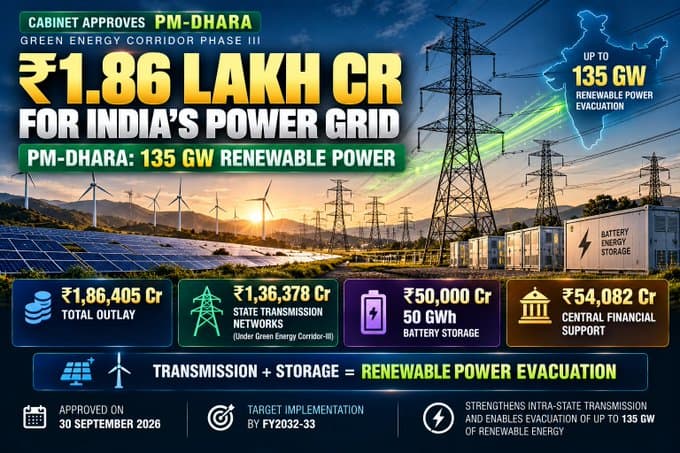
Regulations, reforms, and the rules that move markets — unpacked with clarity, reported with depth.
 Policy
Every country will be controlled by governments and at the same time, it is dependent on business, wealth and taxation to make the country function effectively. There are few important aspects where the policies which are made by the government have a direct and indirect impact on business and its operations overall.
* Whenever there is some kind of conflict across the world, it directly impacts the supply chain and logistics. The government further has to take action to increase taxes and depend on other nations for resources. You have seen that, suddenly, the oil, petrol, diesel, LPG and crude oil prices keep changing according to the circumstances. The price suddenly keeps increasing and decreasing, the stock markets might be bullish or bearish, impacting businesses overall. Whenever they initiate tariffs, subsidies and trade agreements, the prices would automatically fluctuate. It can generate massive wealth and development along with getting absolute security for loss or profit.
* Whenever political parties emerge and gain power. The business rules, laws and regulations keep changing. The tender which has been allocated can be stopped and called for re-tendering. It especially happens more in state governments. The projects keep getting challenged by bureaucratic restrictions and government interference.
* Imagine you are in the carbon business and suddenly the government brings a new environmental law which says it is impacting the citizens and forests. Then cost and expense would increase, or it might completely stop and further lead to legal problems.
* We have many giant players in the markets and have an absolute monopoly. To restrict such dominance, which can impact smaller and traditional businesses, the governments have strong regulations for competition and freedom.
* Today, the government launched a road initiative of 200 km policy. It is indirectly and directly generating supply and demand of assets, increasing the land value, construction, supply of goods and employment opportunities. It can literally change everything with a just law or rule, which can be positive with development or negative with devastating loss.
Bura Anirudh Yadav
August 1, 2026
 Policy
There is always a question and criticism regarding the government's actions and development records. We all think and calculate about the government's spending, allocation, whereabouts of funds and revenue which are being used by the government. Back in time, in Rajasthan and Uttar Pradesh, a few labourers and farmers protested frequently regarding the subsidy money provided by the government for crop failures and schemes. So the officials always used to escape or hide the funds and manipulate poor victims.
Rajesh: My agricultural crops failed due to heavy rains. I have applied and requested the government for compensation. The government has allocated 1000 crores this year to crop failure.
Suresh: Yes, every farmer would get subsidy money, but I am scared that these government officials eat our money without giving us. I don't know where all these government funds have vanished every time.
Rajesh: There should be a strong rule for government's accountability and transparency also.
As time passed, this movement became a nationwide movement across India. People started asking for accountability and transparency in government departments. After huge changes and laws finally in 2005, India adopted the RTI ACT, and it became the 48th nation to bring this accountability and transparency law. It has already been implemented in 100 countries. Section 19(3) of the RTI ACT gives us the right to ask for information from the government regarding documents, funds and developments. Any citizen can apply online and offline by filling out the application. The public information officer would provide details within 30 days, and would provide authentic information regarding the current activities and developments of concerned departments. Except the information regarding national security will not be provided for safety concerns.
This RTI Act 2005 has done tremendous work by exposing one of the crucial scams in India.
* Aadarsh Housing Society: It was meant for the Kargil war army soldier's families, but few bureaucrats and politicians have occupied and sold it for 3 to 8 crore for a total of 31-storey building.
* 2G Scam: The telecom contract was sold for a cheaper price compared to the current market price through favoritism worth 1.76 lakh crore.
* Commonwealth Games scam worth 70,000 crores: The sports equipment and arrangements were overpriced with wrong bills.
* Indian Red Cross society: It was a charitable organization where all humanitarian funds were misused by a few individuals worth 70 lakhs.
The RTI has exposed all these scams with just 1 application and complaint by just asking for the government's accountability and transparency. The citizens can ask for any information and ask for the accountability of the government's actions. This rule and law has given hope for citizens to analyze and understand how governments are working with proof and information.
Bura Anirudh Yadav
July 24, 2026
 Policy
In India government jobs are prestigious and privileged. It takes immense competition for preparing and qualifying the exam. Once you qualify, society assumes your life will be stable for the next 30 years. The perks and advantages you get from governments are so satisfying that your money is safe all the time. The CGHS policy is giving health care benefits to the employees who are working in the government sector. The financial assistance which is provided for every other individual on health, would be deducted from their salary and for retired employees they would pay a large amount for lifetime validity based on grade pay and position they held. A membership card will be provided with date and validity, you have to visit the nearest or your mentioned branch for health check up.
There are almost 2 crore central government employees and state governments around 1.2 crore. The annual fund of the government for this scheme is 2000 crore rupees. Almost 60% of the fund is contributed towards medicines for the diseases faced by people. The CGHS policy is right now working effectively in 80 cities. As per data almost 3,000 rupees are spent by one individual on health per year in India. What about bigger health issues?
The governments intiate all the medicines and facilities given under unani, Ayurveda, yoga & homeopathy, sidha. Till now 43 lakh beneficiaries have used this facility. In an emergency situation, even if you visit private hospitals you would be given relaxations and subsidies or reimbursement. The governments ensures, all the facilities are provided to government employees as they go through abundance of stress, pressure and long hours of sitting and work. The families have benefits and the person working as an employee goes through all the suffering and rigid life.
Bura Anirudh Yadav
July 10, 2026
 Policy
Whenever we watch news channels or parliament debates, In the headlines, we keep hearing about fiscal policy and monetary policy. The percentage regarding the growth and fall. Most of us do not try to understand what it is. We simply skip or just look at it, as data pointers from the government.
Let's try to understand fiscal policy which is controlled by the Ministry of finance, when the governments measure and regulate the actual development of past, present and future outcomes. It helps in preparing budgets, debt, taxation procedures, laws, increases or decreases and overall spending and expenditures. It calculates all the revenue collected and estimates the revenue allocations of overall India.
When it comes to monetary policy, it is controlled by the RBI, which is an independent body and has its own decisions based on India’s economic circumstances rather than political influence. Its major focus is on borrowing wealth and interest rates. Deciding the Repo Rate and Reverse Repo Rate of loans which have been taken by governments or which we have borrowed from other nations and banks providing loans at what price. It decides the actual figures and data, on what basis the financial institution should work. Irrespective of the governments they keep a watch on the overall money flow to control inflation and to protect against economic crises hitting India.
Fiscal Policy and Monetary Policy are two pillars of balancing the nations. For regular activities and development procedures, the government deals with them and, when it comes to the overall safety of the economy, monetary policy works effectively.
Bura Anirudh Yadav
July 1, 2026
 Policy
Rahul: I need a job but I dont have any skills.
Suraj: ok dont worry, the government is starting PM Setu.
Rahul: What is it ?
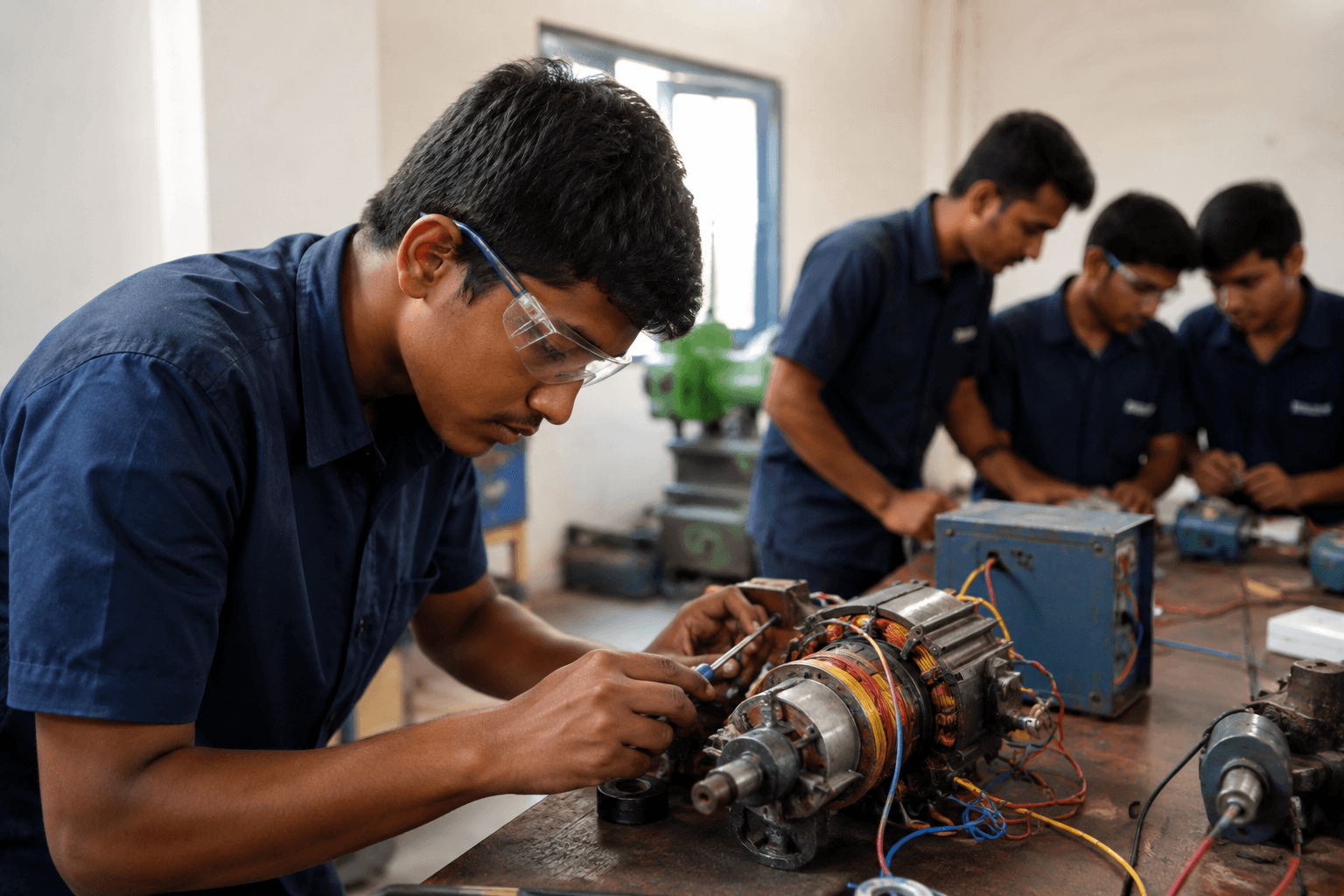
Suraj: To build 1000 Industrial Training Institutions worth 60,000 crore to provide the right industrial-based skills.
Due to the modern changing world and as the population increased. Creating employment and skilled personnel is important and requires changes in structures and systems. Industrial Training institutes have created hundreds of mechanics, plumbers and skilled personnel which are necessary for industries. It is basically to help employment generation in various sectors based on industrial needs. The skills which many possess are not industry-based, and do not create jobs. So the government wants to create jobs based on industrial needs only.
The government of India has launched the PM Setu policy.
* It is to create 1000 ITI’s (Industrial training institutes) across the nation.
* With a budget allocation of 60,000 crores in 5 years, it would create 20 lakh jobs indirectly and directly.
* It would focus on real jobs based only on industry requirements and introduce industry leaders to the training curriculum.
* PM-SETU (Pradhan Mantri Skilling and Employability Transformation through Upgraded ITIs) plans to launch in 5 circuits: Kanpur, Ludhiana, Hyderabad, Chennai, Bhubaneswar.
* The government already plans for 1200 labs in schools and colleges across India.
* Students who are in 10th class can join these institutes or industrial working personnel can join.
Bura Anirudh Yadav
June 24, 2026
 Policy
Rahul: I want to start my own factory, but you know how difficult it is to open a factory in India.
Mukesh: Yes, from land acquisition to bureaucratic hurdles and capital loss. I can understand your pain.
To overcome this, the government of India has launched the Bhavya Scheme.
Why government wants to construct it ?
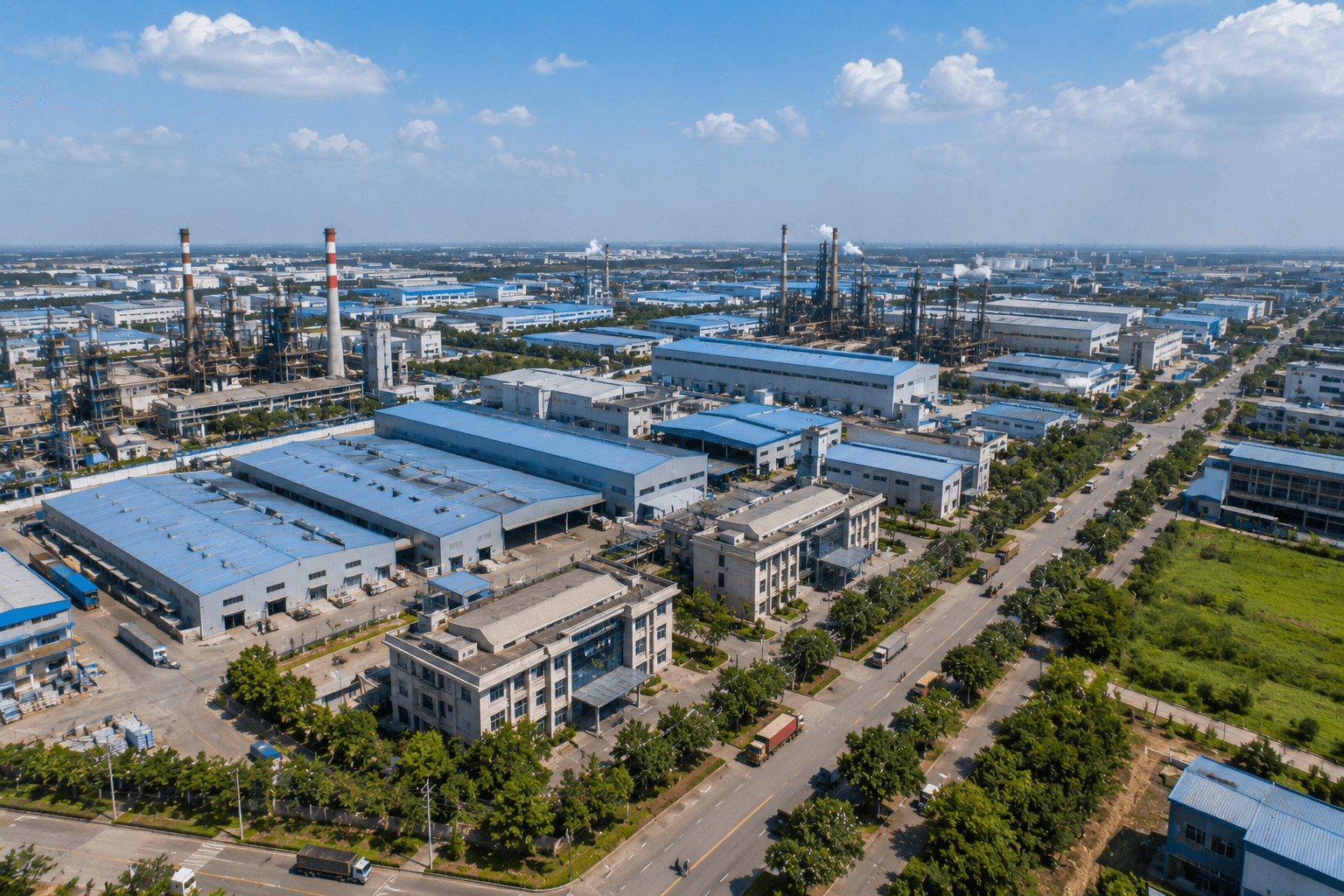
The problem is establishing an industry, it takes a lot of time, energy, paper work, funds and bureaucratic delays. Many businesses and investors suffer due to rules, regulations and sometimes corruption. The documents and files are kept on the desk for years and not approved because of lame reasons. So, the government’s policy is to construct 100 industrial parks across India worth an amount of 33,660 crore rupees.
It would create 15 lakh indirect and direct jobs and the nodal agency would be the National industrial corridor development corporation and which comes under Ministry of Commerce and Industry. The government would construct core infrastructure facilities and create an eco-system for all the factory needs.
* Only machinery and production is the only work for investors. That's the major motive of the government.
For general areas, 100 acres of land would be taken and for tribal and hilly areas there would be 25 acres of land. It is an initiative to remove old procedures and bring innovative fast-track-based systems to business.
It comes under Make in India, employment generation and a target of Viksit Bharat 2047 vision.
Bura Anirudh Yadav
June 17, 2026
 Policy
Rahul: The petrol prices are hiked again, I'm fed up with filling petrol in my bike.
Sonu: Why don't you try EV vehicles, it is the best trending vehicles right now.
Rahul: Really ? What is the procedure for EV vehicles? I have so many questions in mind regarding EV.
Sonu: I can understand what you are going through. Please share.
Rahul: * What is the cost of the EV ?
* How far can I go ?
* What about its charging station and time ?
* Do you think it is long-lasting ?
Sonu: Don't worry. Yesterday, my brother said that people who bought an EV can go without fuel at less cost and People with petrol bikes say, let's race. So that's the metaphor-like difference between both.
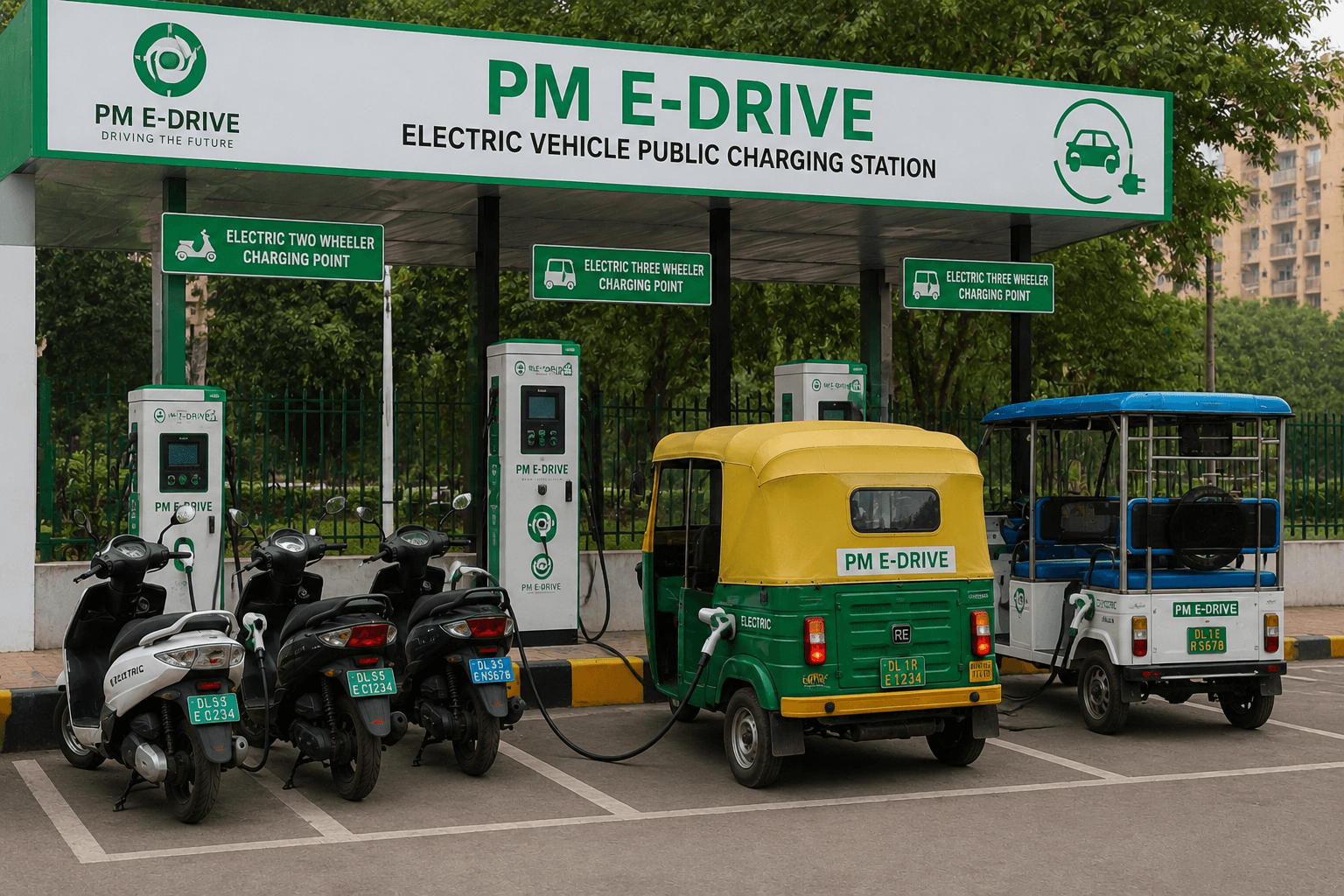
The government of India has launched PM E Drive with an amount of 10,900 crore. They would help 25 lakh 2-wheelers, 3 lakh electric 3-wheelers, 14,000 e-buses and electric cars are excluded from this list. The government would give subsidies and provide public charging stations. The major focus is on urban areas right now. You can already see green number plate of vehicles on the streets. The government would also provide E- Vouchers and benefits.
Why should you buy an EV Vehicle ?
The energy crisis in India and due to India importing most of the petrol and diesel from other countries.
The future resources will be run completely on electricity as it saves fuel and protects you from pollution. It has less speed and power, which can protect you from over speeding. People less than 18 years can also prefer this with their parents' permission. Most importantly, it is less expensive than petrol vehicles.
The challenges
* Takes time to charge and has fewer charging stations.
* Only good for local use and has low power, compared to petrol vehicles.
* Many Ola Vehicles have reported service issues and sudden breakdown of vehicles, which led to burning of vehicles.
* In case of damage, it is hard to find a mechanic to repair it instantly.
Overall, EV vehicles are the future of India. The oil resources are being completely imported and have turned expensive. The natural resources have been reduced compared to before. Electric vehicles are the only solution for the next generations.
Bura Anirudh Yadav
June 10, 2026
 Policy
Son: I'm hungry, I want food to eat.
Maa: Your father has lost his job, it's the time of COVID. People are dying due to deadly diseases. We are poor, I can't feed you food.
Father: I am back home.
Maa: Look, your son is hungry, you have lost your job. All savings are finished. How can I arrange food?
Father: I understand your grief and pain. It's not our only problem. Every other person is facing such a problem.
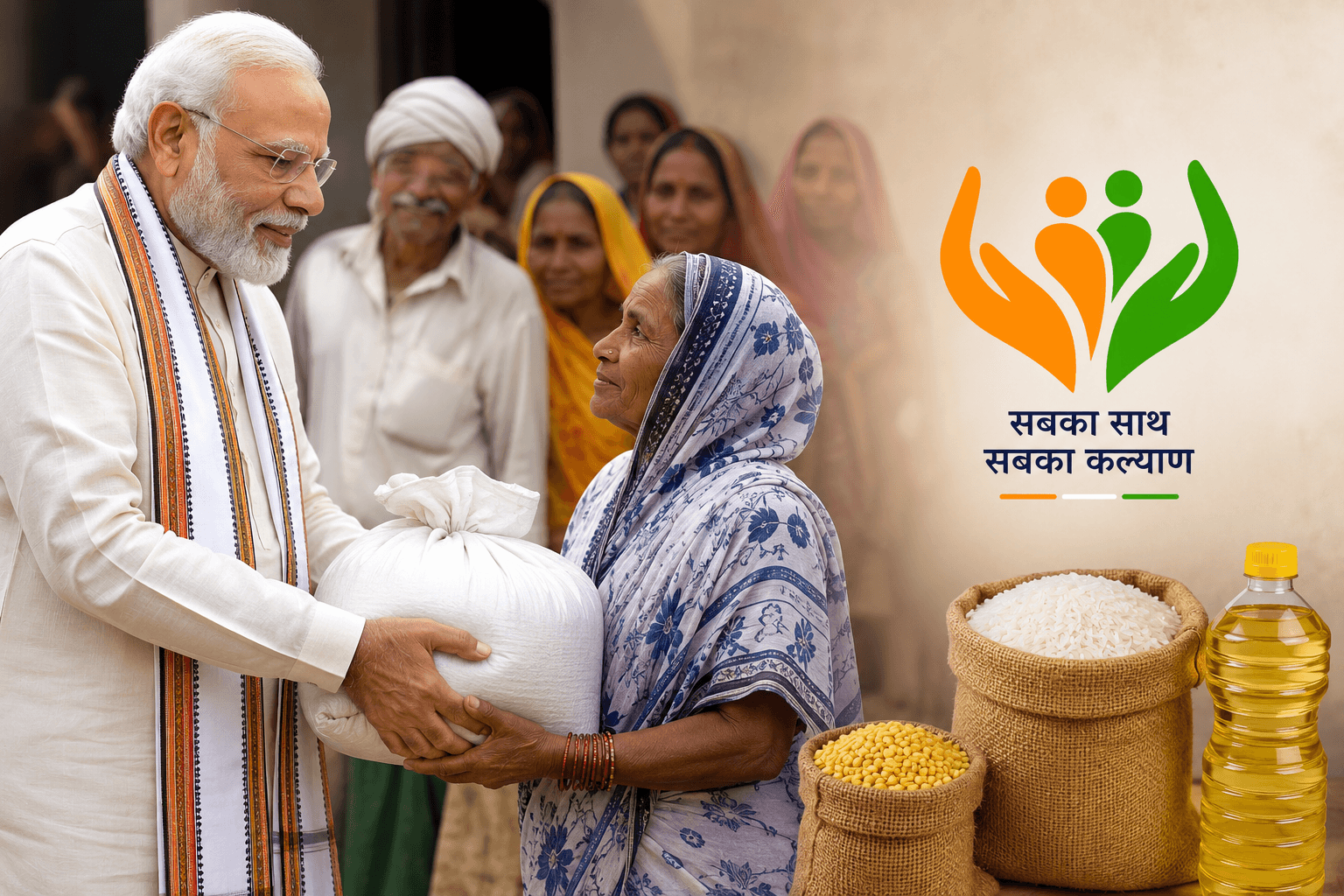
Don't worry, the government of India has initiated Pradhan Mantri Garib Kalyan Yojana. It will provide us with relief from hunger problems. They will provide you with 5 kg of food grains and 1 kg of pulses. This started in COVID, which later got extended, as it helped a lot of poor and marginalised people. Almost 81.35 crore people benefited from this scheme. It is one of the biggest food security policies, where nobody stays hungry. Its been 12 years since the scheme has been launched.
The eligibility of the policy is that anybody who is poor who is below the poverty index is eligible. Elderly people above 60 years and who are widows are also eligible. It is under the ministry of finance as it is a nodal agency, but the distribution process is done by the Ministry of consumer affairs & public distribution. Did you know the amount allocated from 2026 to 27 is almost 2.27 lakh crore fund. The biggest advantage of the scheme is our hardworking farmers' cultivation of rice and wheat is being bought at MSP price by the government and that is being redirected to 81.35 crore poor people to protect them from hunger.
Bura Anirudh Yadav
June 8, 2026
 Policy
*Do you know how much our street vendors suffer ?
Per day they make around 300 rupees by selling on streets.
*Did you ever think of their families or children ?
*To start a business, do street vendors need a support system or not ?
*What about their dreams and aspirations ?
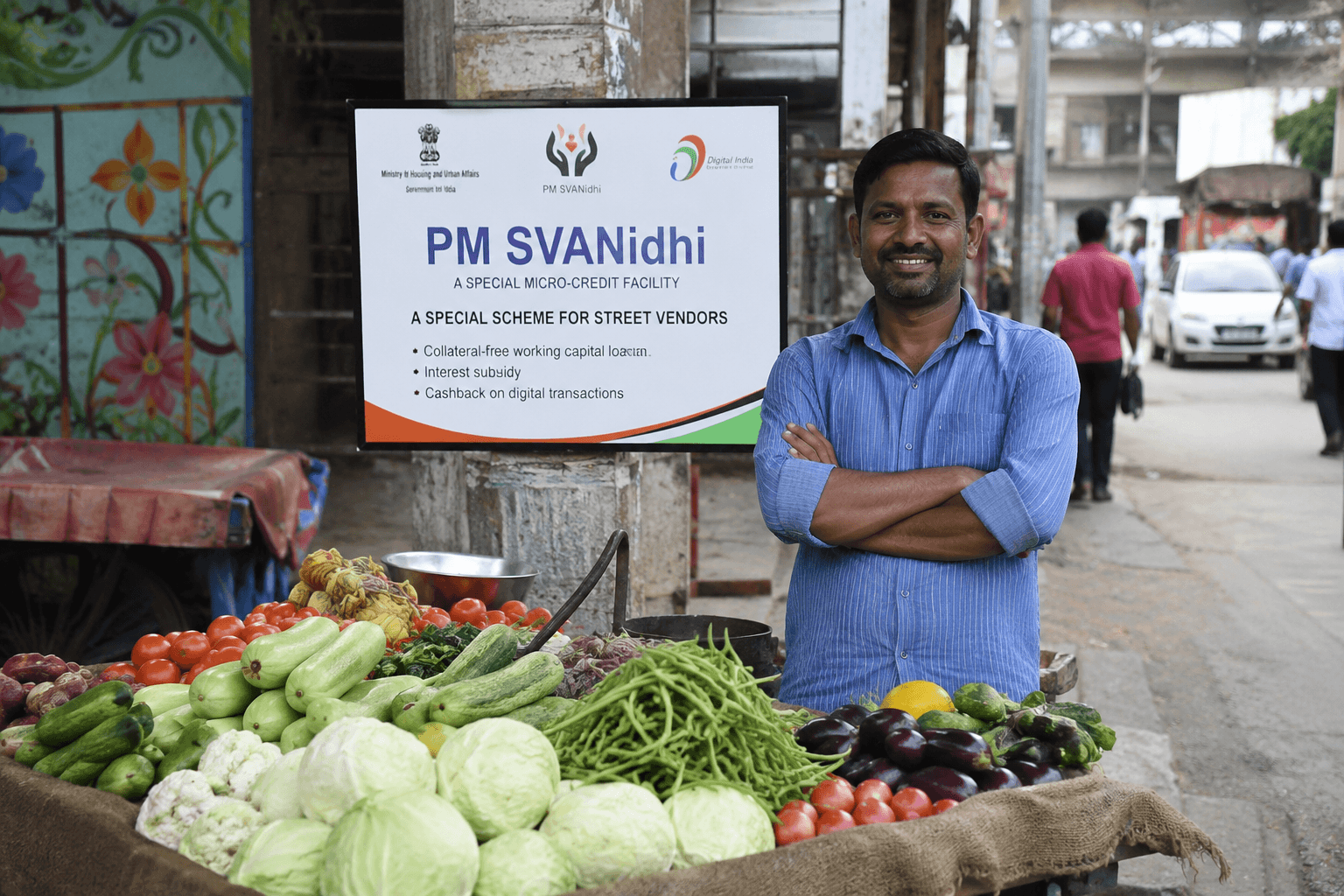
During COVID, many people lost their lives. Due to that, many street vendors lost their livelihood. If any street vendor lost his job or wanted a loan, for them government of India initiated the PM Svanidhi scheme.
The government launched an intiative by providing loan without any collateral. Which indicates that a street vendor who takes and repays loans up to 15,000 is eligible for 25,000 in the second stage of the loan-taking process and a vendor who repays past loans on time will be eligible for 50,000. The eligibility for this scheme is anybody who is 18 years old. Would get about a 7% interest subsidy from the government. You can apply for PM SVANidhi through the official PM SVANidhi portal. You can also apply through participating banks, microfinance institutions, or a nearby Common Service Centre.
The government about 1.2 crore loans have been given, which is more than 17,800 crore. About 75+ lakhs vendors have got benefits. A UPI Rupay card was also launched. These initiatives are the major source of vocal for locals.
Bura Anirudh Yadav
June 1, 2026
 Policy
Ramesh: Do you know the government of India initiated modernize public distribution system ?
Suresh: Yes, they are going to use AI, machine learning, blockchain and monitoring systems.
Ramesh: What are the benefits of it ?
Suresh: It improves transparency, accountability, improves data-driven, last-mile distribution process reaching every individual, and citizen-centric governance. It reduces corruption and fake ration cards.
Ramesh: Can the government handle the 80 crore beneficiaries ?
Suresh: Yes, they recently sanctioned 25,530 crore funds.
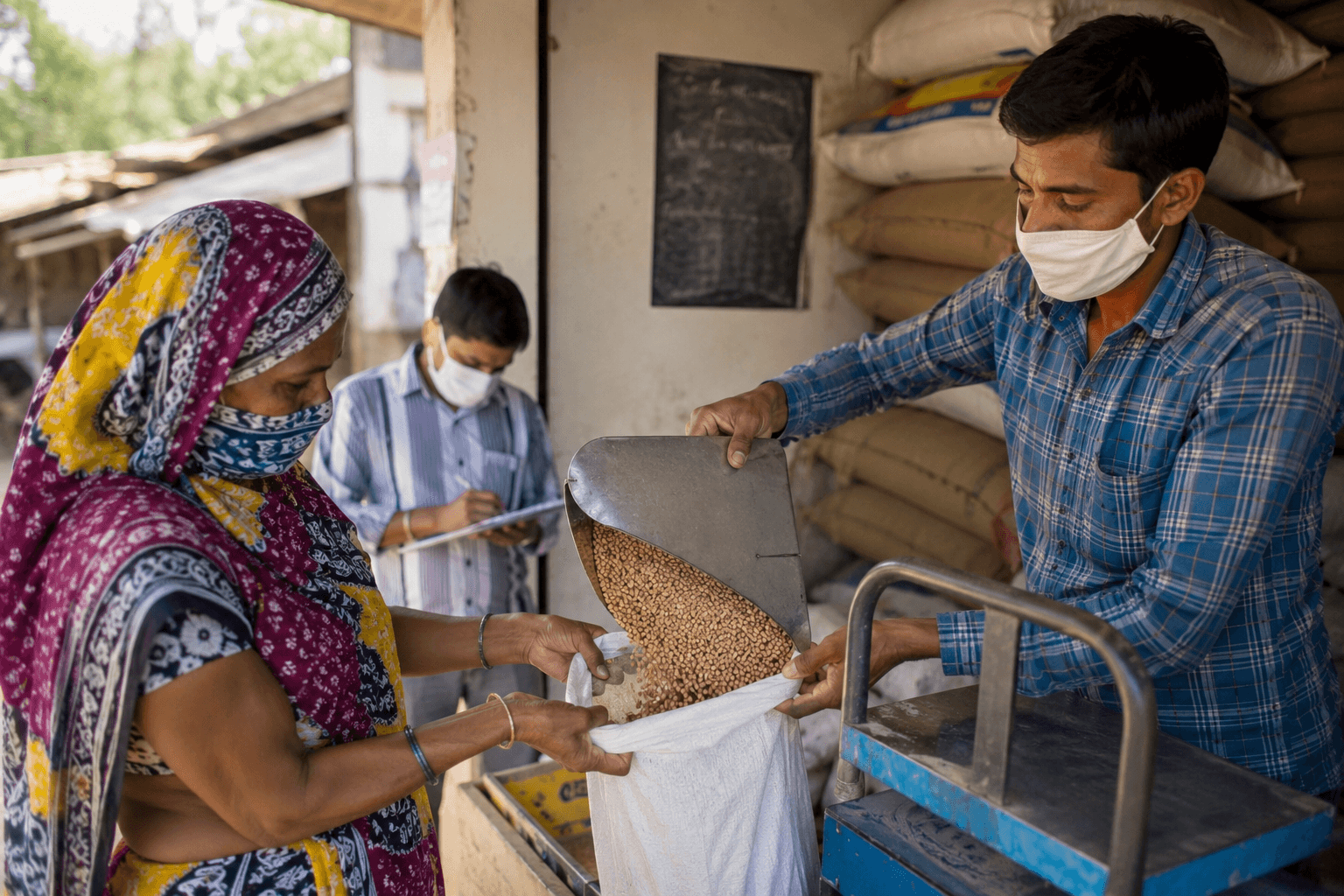
SARTHAK-PDS Scheme is a government policy designed to help India’s Public Distribution System (PDS). The main aim of this scheme is to make the distribution of food grains like rice and wheat more transparent, efficient, and fair for all eligible people under the National Food Security Act.
*It improves faster and more efficient delivery of services
*It helps reduce leakage and wastage of rations without any misuse, which used to happen.
*The shopkeepers can manipulate the prices or increase according to profit but it will be removed now.
SARTHAK-PDS is a beneficial policy initiated by the government. It would definitely help to provide authentic food grains to the poor and increase the potential of welfare by monitoring with advanced tech systems.
Bura Anirudh Yadav
May 30, 2026
 Policy
Ramesh: I started my business. I need funds to scale the business. How can I arrange funds quickly?
The procedures of banks and frequent repeated visits, will take at least 1 to 3 months. I don't know what I should do ?Suresh: Congratulations, but don't worry brother, you can get a loan in just 59 minutes.
Ramesh: Oh 59 minutes ! How is it possible ?
Suresh: Yes, I am talking about PSB loans in 59 minutes. It is a government initiative to get a loan process in 59 minutes. You can get a loan of 1 lakh to 5 crores. With interest rates as per the amount, which is also collateral free for small amounts and for big amounts, you require collateral.
The procedure is simple and quick within 59 minutes. All you need is your required documents to be submitted digitally.
*Like Aadhar, Pan, GST, Udyam certificate, Cibil score, income tax returns of 2 years, company turnover, business plan, you can pay back a loan on an EMI basis.
Your procedure will be done within 59 minutes, but the sanction and approval will happen after 7 to 10 working days.
PSBloansin59minutes you browse and choose your category for loan.
*Micro, Small, and Medium Enterprises (MSMEs)
Bura Anirudh Yadav
May 27, 2026
 Policy
Are you willing to start your own business ?
Do you have the required skills to start your entrepreneurship journey ?
I know business, but I don't have mentorship then ?
Yes, if you're 18 years old and eagerly waiting to learn skills, then you are at the right place.
The government of India in the MSME sector has initiated skill-based training for all young people coming from backward places and regions. Having deep regard for entrepreneurship and growth.
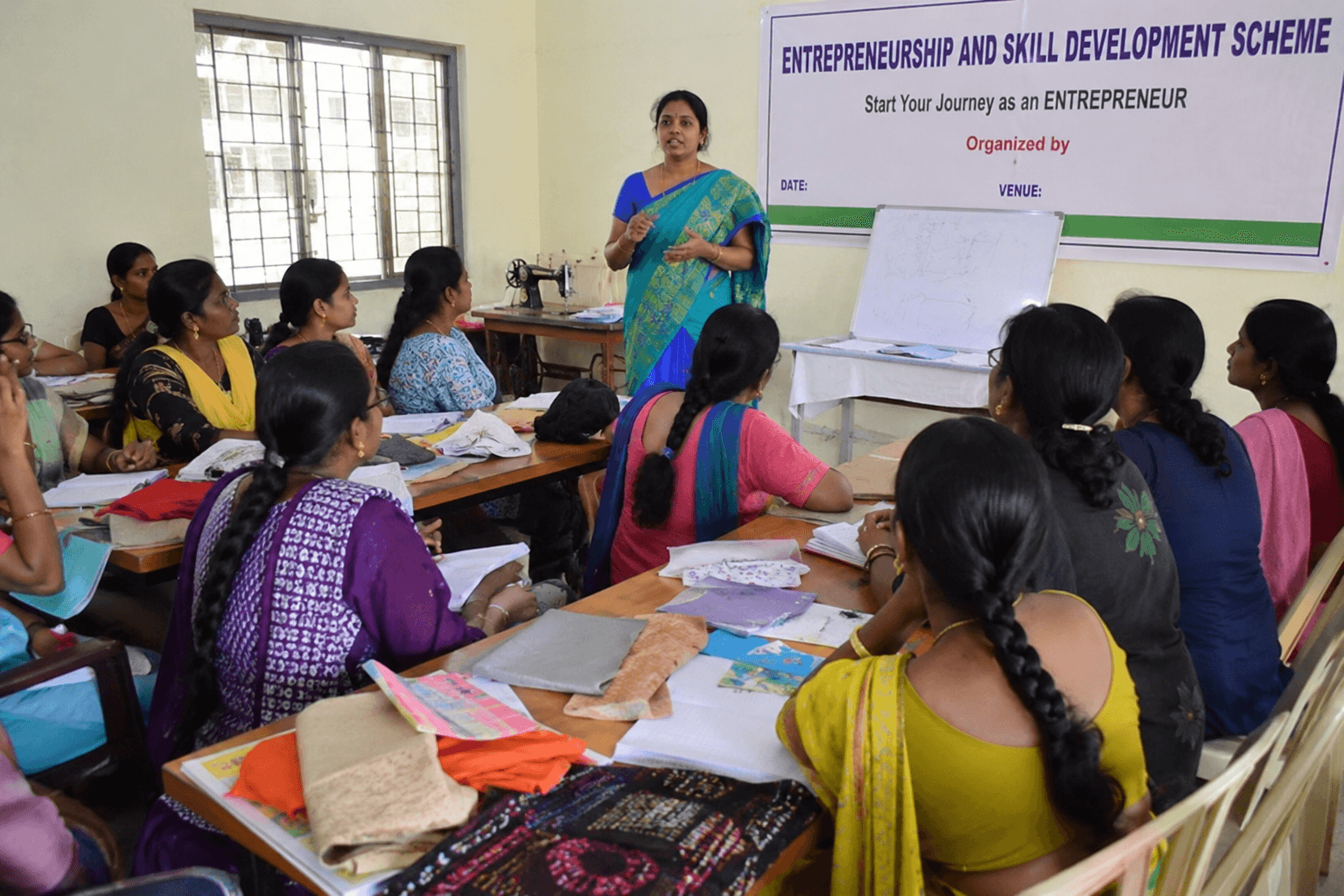
The Entrepreneurship and Skills Development Scheme helps people learn useful skills and start their own businesses.
The government teaches computer skills, tailoring, mobile repairing, beauty services, electrical work, food making, and many other job-related skills. Students also learn communication, teamwork, and basic English speaking.
Entrepreneurship training includes
*How to start a business,
*Manage money,
*Sell products,
*Use digital payments
* Apply for bank loans.
Data
More than 12.75 lakh people received entrepreneurship training, while India now has 14,688 ITIs and over 15,500 PMKVY training centers, including 7,000+ Skill Hubs in schools and colleges. For FY 2026–27, the government allocated ₹9,540.50 crore for skill development schemes, along with a ₹60,000 crore PM-SETU program to modernize 1,000 ITIs across the country. More than 26,000 enterprises have been created under various programmes
These programs help unemployed youth people become self-dependent and earn an income. Many courses are free and provide certificates after completion. The scheme supports skill development, self-employment, and better job opportunities for young people across India.
These can be applied online at Skills India Portal and offline near skill development centers which are nearby, where you can apply for weekly courses based on your interest. Take your basic documents to apply for and start your business journey with new skills.
Bura Anirudh Yadav
May 25, 2026
 Policy
A change in traditional to modern methods for BPL women.
Do you know in India many women still use traditional methods for cooking? Rural women especially still use cow dung, firewood, and other local materials for cooking. Have you seen rural women blowing with iron pipes and plastic pipes while cooking, their pain of coughing due to smoke and other harmful gases while cooking?
Many women face lung issues, tuberculosis, hypertension, high blood pressure, acute respiratory diseases just because of cooking with traditional methods. Constantly inhaling smoke by the poor women. What sin have they committed just by cooking ?
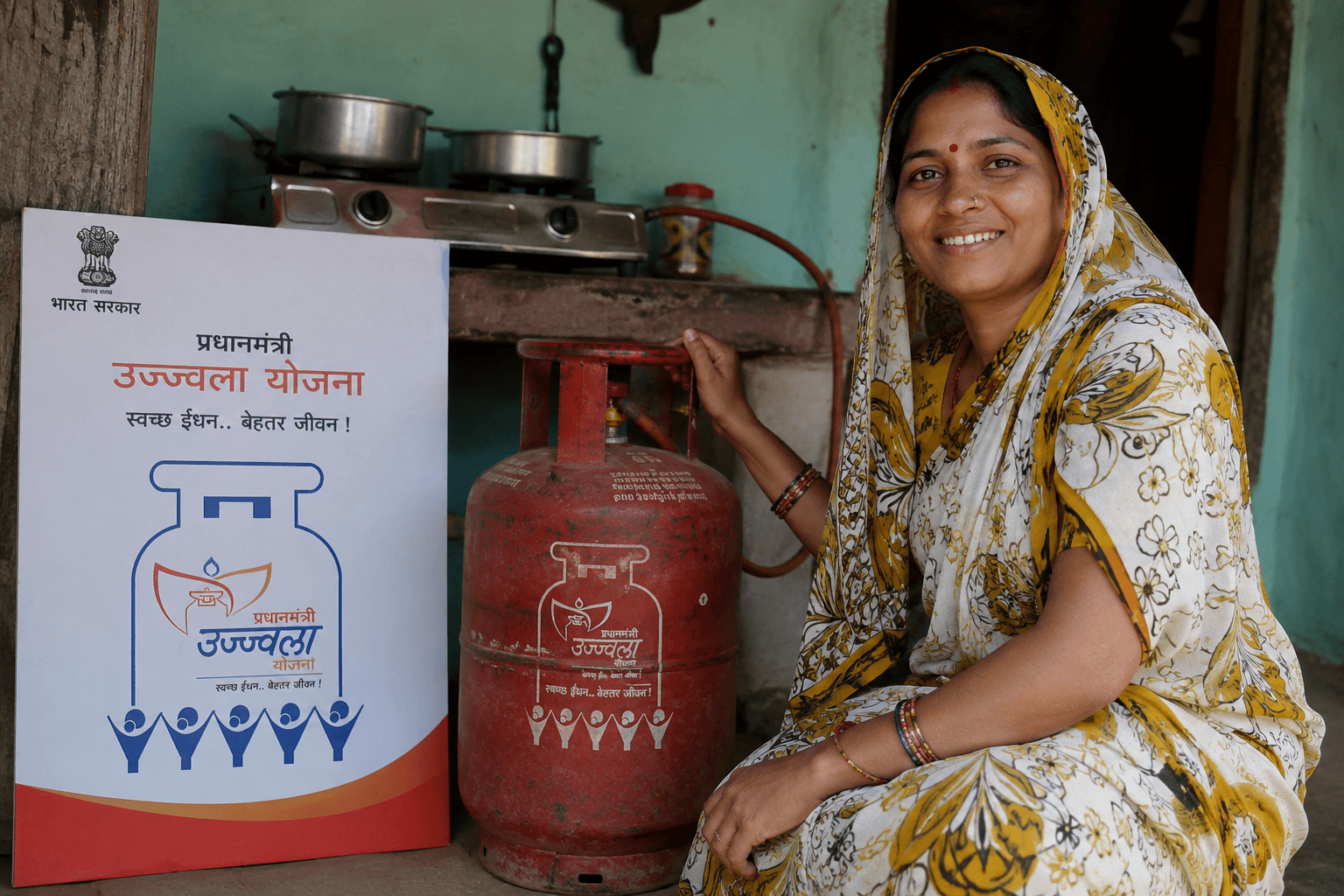
By looking at all these problems, the government of India launched the Ujjwala yojana to provide LPG connections to BPL citizens. The government has provided almost 10.55 crore connections per year 9 to12 cylinders, 14.2 kg cylinders, and a subsidy of up to 300 rupees for BPL citizens. The data is taken from the official website.
The documents required for applying for LPG connections
*Address proof
*Ration card
*Bank account
*KYC
*Should be 18 years.
You can apply offline and online at your nearest gas agency or on the PMUY portal.
Bura Anirudh Yadav
May 22, 2026
 Policy
Due to expensive research and development, many business ideas fail.
Research happens in labs and institutions, but products do not reach till markets.
To fill the gaps between research and business, the government launched the Multiplier Grants Scheme.
The government would support it directly with grants of 2 crore per project and consortium would get up to 4 crore. The project duration should be 2 to 3 years.
Funds are released directly to academic or R&D institutions.
The Multiplier Grant Scheme is a government scheme by the Ministry of Electronics and Information Technology to support research and innovation in India. It encourages industries and academic institutions to work together on technology projects and new inventions.
Under this scheme, when a private company invests money in a research project, the government provides additional funding as a “multiplier grant.” This increases the total support available for innovation and product development.
Objectives
* Promote research and development in India
* Encourage industries and academic institutions to work together
*Support innovation and new technology projects
*Increase private sector investment in research
*Develop products and solutions useful for society and business
*Strengthen India’s technology and startup ecosystem
*Create skilled jobs and improve technological growth in the country
Eligibility
*Indian companies and industries
*Recognized research institutions and universities
*Projects related to IT sector & Electronic
*Joint projects between industry and academic/research organizations are preferred.
Bura Anirudh Yadav
May 20, 2026
 Policy
Are you seeking loans ?
You want to start business ?
Yes, from the government portal, which was initiated to get loans easily.
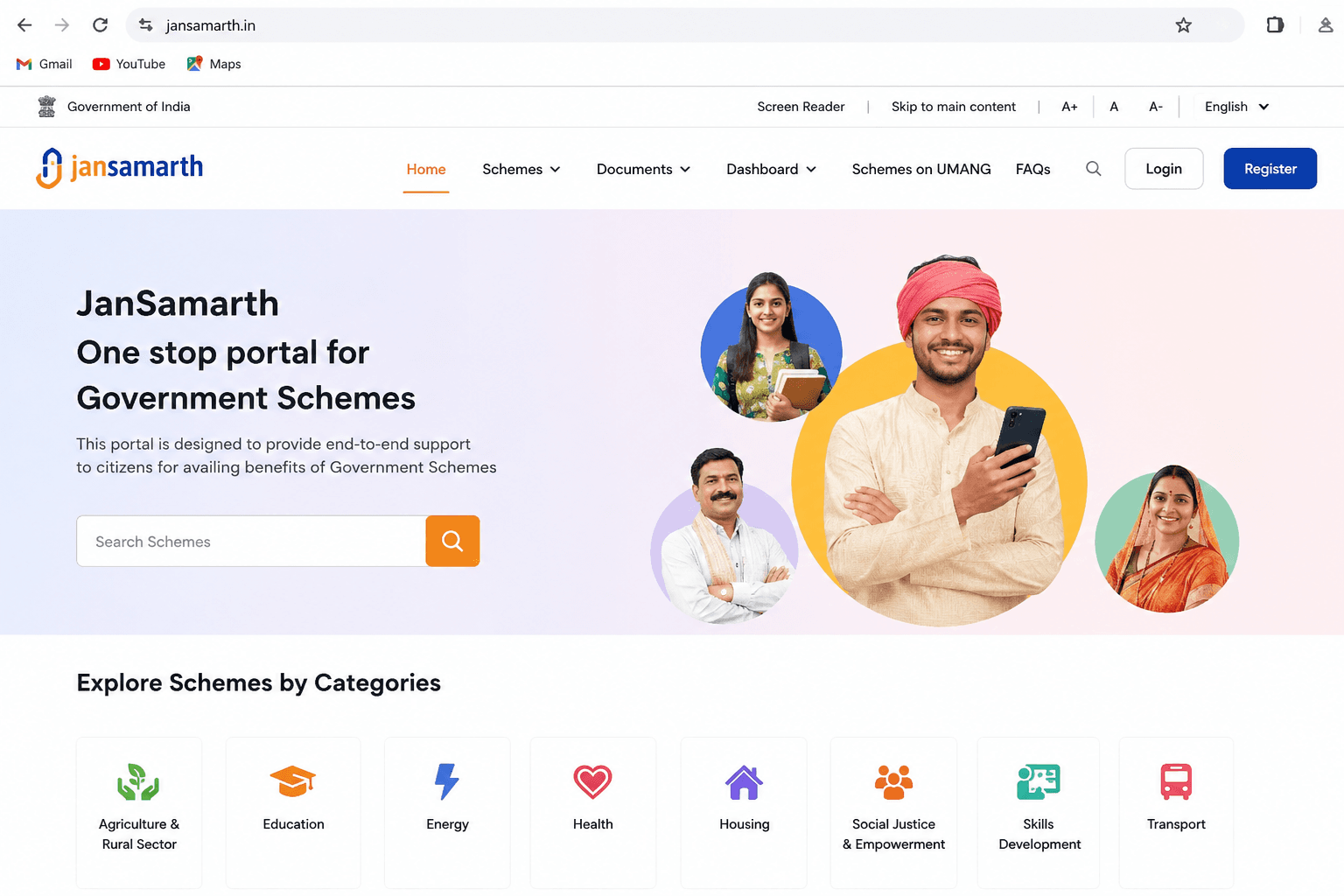
The JanSamarth Portal is a single digital platform launched by the Government of India to connect people with multiple government loan schemes. It works as a “one-stop portal” where individuals, farmers, MSMEs, startups, and students can find and apply for credit-based government schemes in a simple way without visiting many offices or banks separately.
The portal covers around 15+ government-linked credit schemes across different sectors.
* These include agriculture loans, education loans, MSME business loans, startup funding support, and livelihood-related loans.
*Some important schemes available on the portal are MSME credit support schemes, agricultural infrastructure finance, education loan schemes, and business startup loan options supported through banks.
The benefit of JanSamarth
*Ease and transparency.
* Applicants can check eligibility online, compare schemes, and apply digitally. It reduces paperwork, saves time, and connects applicants directly with participating banks and financial institutions. It also provides a clear tracking system for loan applications.
Eligibility depends on the scheme.
*Applicants must be Indian citizens
* categories like farmers, students, MSME owners, startups, or individuals seeking livelihood support.
*Each scheme has its own rules regarding income, credit score, business type, and documentation.
*The application process is simple. Users register on the portal, select a scheme, fill in personal and financial details, upload documents, and submit the application. The bank or financial institution then reviews the application and proceeds with approval and disbursement.
*Overall, JanSamarth Portal acts as a bridge between government schemes and beneficiaries, making access to loans faster, more organized, and transparent for millions of people in India.
Bura Anirudh Yadav
May 19, 2026
 Policy
Have you ever thought, if we all focus on getting job. Then who will provide a job.
Depending on the public sector would only benefit a few individuals and governments can provide limited jobs.
Then what about others ?
Have you heard of the Atal innovation mission ?
Which basically provide entrepreneurship and innovation worldwide.The Atal innovation mission is an ambitious mission which creates a sustainable future through innovations. The government launched to support young people of our nation to start problem-solving startups. It was started by Niti Ayog with an allocation of 2,750 crore by 2028 with a robust ecosystem for startups. The Aim is to create proper human capital development, innovation, research-based, tech-based and international innovation systems. It launches new programs and policies, establishes standard platforms for creativity, and creates awareness regarding startups and their benefits.
1. Atal Tinkering Labs
Schools-based labs where students learn innovation and STEM skills.
They build models, robots, and do hands-on experiments.
2. Atal Incubation Centres
Support startups by providing funding, space, and mentoring.
Helps new ideas turn into successful businesses.
3. Atal New India Challenges
Encourages solutions to important national problems.
Supports innovators with funding to develop useful products.
4. Mentor India Campaign
Connects experienced mentors with students and startups.
Guides them to improve ideas and innovation skills.
5. Atal Community Innovation Centres
Promotes innovation in smaller towns and rural areas.
Gives facilities to local entrepreneurs and students.
6. Atal Research & Innovation for Small Enterprises
Helps small industries and startups with research support.
Encourages technology-based solutions to industry problems.
Data
*10,000 Atal Tinkering Labs established across India in schools.
* Over 1.1 crore students are actively learning innovation skills.
*72 Atal Incubation Centres (AICs) were set up for startup support.
More than 3500 startups have been incubated.
*These startups have created around 32,000+ jobs in India.
*Over 1000+ startups led by women entrepreneurs are supported.
*Around 6200+ mentors (Mentors of Change) guide students and startups.
*AIM has also launched national innovation programs like Atal New India Challenges and ACIC centres to solve real problems.
Atal innovation mission has done tremendous growth in the last few years. It would definitely scale up our growth for the future India. The innovation mindset would set large-scale benchmarks in young startups and entrepreneurship.
Bura Anirudh Yadav
May 16, 2026
 Policy
A few years ago when we used shoes, we all used to see Made in USA, UK, Germany or China.
But today we see Made in India on every other goods and in fact, we have started exporting made-in-India goods on a large scale.
Isn't it a good change in India, which happened ?
Self-Made, Self-worth and Self Growth.
Make in India has 4 major pillars: new processes, infrastructure, new sectors and new mindset.
Make in India is a policy which encourages us to develop, manufacture and assemble indigenous work. India today is dependent on other nations for goods and services. The smallest of things are imported from other nations. From ice cream sticks to weapons. The amount of money we pay to countries is unimaginable. So they launched it in 2014, and it's been more than 10 years.
How the government is working on it.
Sectors involve almost 27 sectors, like aerospace, weapons, textiles, leather and food processing, and many more sectors which have been working effectively in manufacturing.
Production-linked incentives programs were initiated which worked on 17 sectors. Launch of PM Gati Shakti, Startup India, national logistics, tax reforms, unified payment interface, ease of doing business are among important intiatives.
Achievements
Vande Bharat Indian made trains, COVID-19 vaccinations, textiles, 400 million toys made in India, the defense sector. India’s rank in ease of doing business is 142 in 2014 in 2026 it's 63rd rank worldwide. India fetched $4.3 billion FDI funds and in 2024-25 around $70 billion investments.
Make in India is the future of India, which has a significant impact in India. Where the government is constantly working to enhance the growth of India through creating large scale policy changes across various sectors.
Bura Anirudh Yadav
May 15, 2026
 Policy
Just Imagine
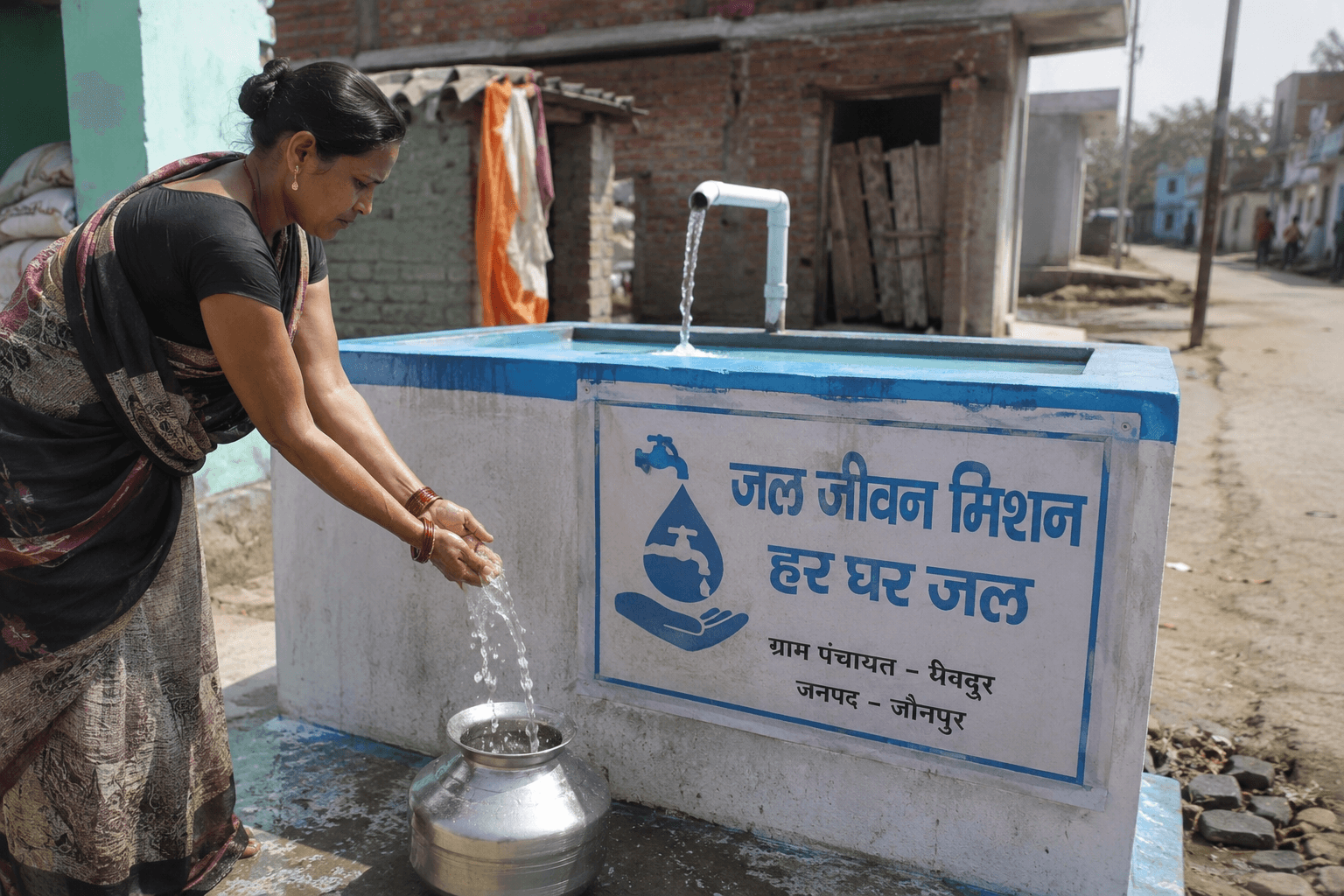
* Rural women carrying water from nearby lakes and walking 4 miles a day, along with the child. How difficult is it for those poor women ?
* The struggle of rural women and their pain was no less than a war. Constantly struggling with the water crisis, from agriculture to household utility.
* Have you heard of Jal Jeevan Mission launched in 2019, its aspirational project of filling tap water facilities for every rural household?
* During the inspection, around 17% approximately 3.23 crore population only had tap water connections, which was a low number by then. The government took a firm decision to provide a water facility.
The key motives of government
* To provide tap water facility
* Special concern about drought-prone, flood-hit, hilly regions, and coastal areas.
* Schools, Anganwadi centers, gram panchayat buildings and health wellness centers.
* Digging artificial lakes, water security zones, rainwater harvesting techniques.
* Developing human resource and water management.
Overall, providing water for rural areas is the major motive.
Data and Analysis of water.
Water is an essential need for every human life in nature. As our ancestors used to say, without water there is no life on earth. Protecting and preserving is essential for a sustainable earth. 97% of the earth is salt water and only 2.5% of the earth is freshwater.
Who owns most freshwater reserves?
*America: Contains the largest share of global freshwater resources at 45%.
*Asia: Holds 28% of freshwater but has the lowest resources per inhabitant.
*Europe: Possesses 15.5% of freshwater resources.
*Africa: Holds 9% of freshwater resources.
When it particularly comes to India, we face severe water shortages during summers, especially in urban areas, where the population density is higher. Nearly 40% of households are dependent on groundwater resources and rainwater, which is seasonal and further results in floods and droughts.
Jal Jeevan Mission Data ( Reference from Press Bureau of India )
As of 2024, almost 77% of rural households have tap water connections; an additional 11.82 crore connections have been given. According to the World Health Organization, almost 5.5 crore hours are saved every single day. Almost 4 lakh deaths can be saved due to safe drinkable tap water.
How did this mission become successful, and how did the government execute it?
*Involving 14,000 + NGO groups and training around 24 lakh women for this mission.
*Har Ghar jal, Nari Shakti se Jal Shakti, Nal jal mitra programme campaigns
*Establishing Pani samitis and community building.
*Village water sanitation committees
*Jal Shakti Abhiyan: Catch the Rain
*Village level planning and execution by visiting village by village.
These were key initiatives how the tap water reached every household as per targeted vision.
As of 2024, almost 77% of areas have been given to water facilities across India. The campaigns and village level monitoring have created an effective and efficient strategy.
Bura Anirudh Yadav
May 13, 2026
 Policy
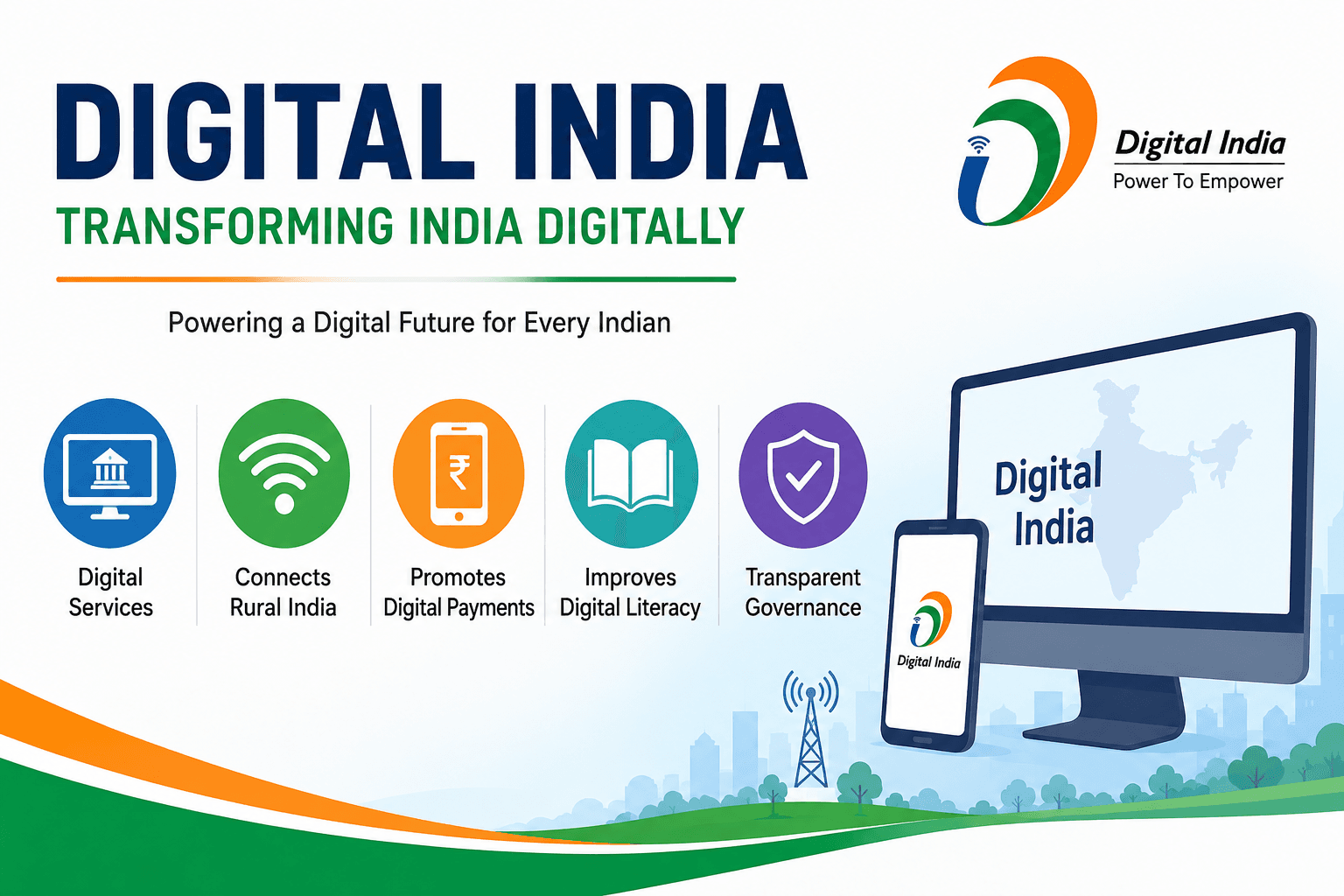
Government of India launched the Digital India campaign on 1 July 2015 to improve online infrastructure and make digital services available to every citizen. The initiative aims to connect rural areas with high-speed internet and promote digital literacy across the country.
The main objectives of Digital India are:
*Provide government services online
*Increase internet connectivity in villages
Some important features of Digital India include:
*Online government portals
Digital India has provided many advantages:
*Faster access to government services
Despite its success, Digital India still faces some challenges:
*Internet issues in rural areas
Digital India is one of the most important initiatives taken by the Government of India. It is helping India move toward a modern digital economy. With better implementation and awareness, this policy can improve the lives of millions of citizens in the future.
sonu vaishnav
May 12, 2026
 Policy
India is one of the world’s largest automobile markets, with millions of vehicles sold every year. For decades, petrol and diesel vehicles have dominated Indian roads, shaping the country’s transportation system and industrial growth.
However, rising fuel prices, increasing pollution, and global climate concerns are now pushing the country toward a major shift — electric vehicles.
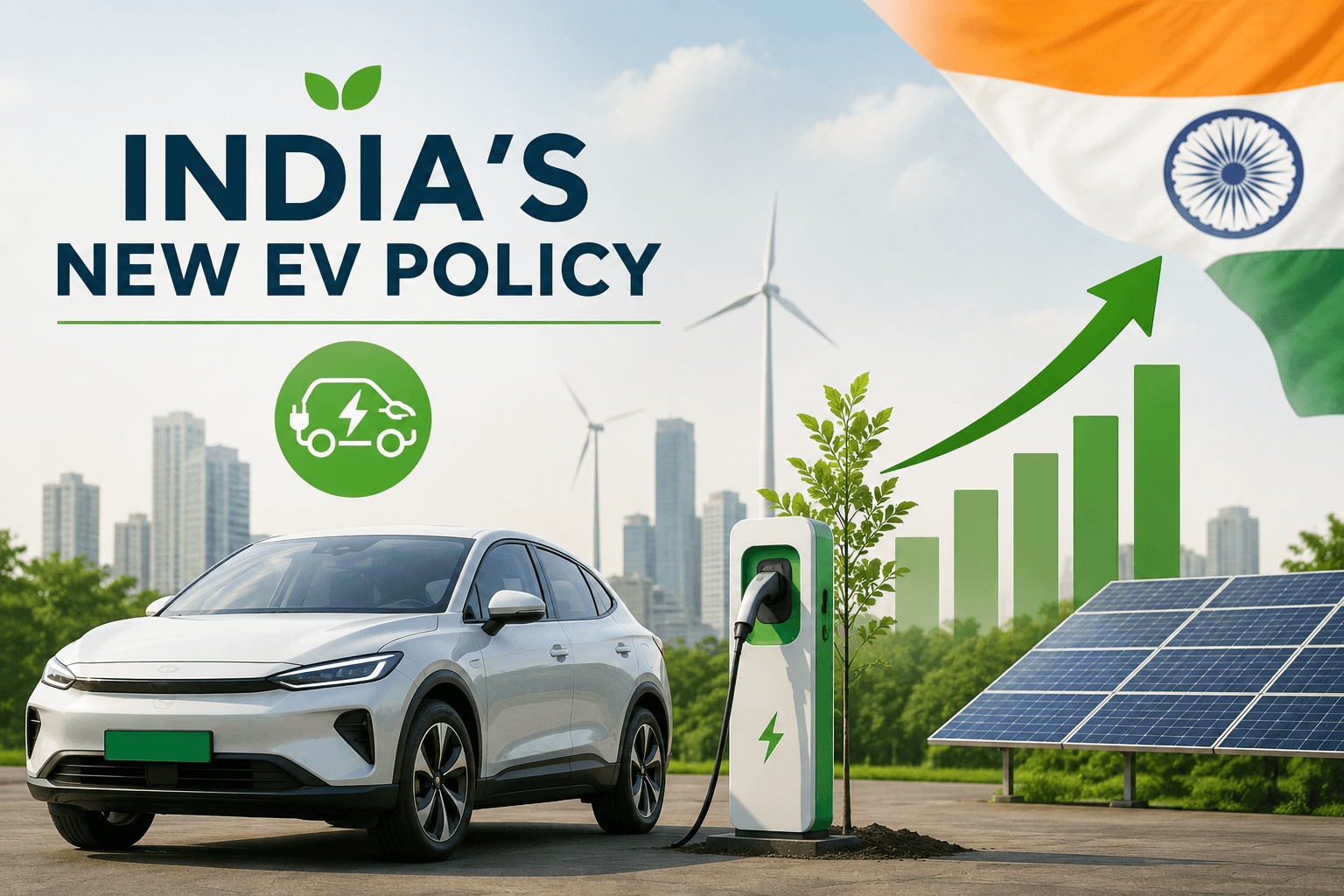
To support this transition, the Government of India has introduced new EV policies aimed at boosting electric mobility, encouraging manufacturing, and reducing dependence on fossil fuels. These policies are not just about promoting electric cars; they are part of a larger effort to transform the future of the Indian automobile industry.
India’s electric vehicle policy focuses on increasing the adoption of EVs across the country while strengthening local manufacturing and infrastructure.
The government has introduced several initiatives and incentives to support EV companies, battery manufacturers, and consumers. The main goal is to make electric vehicles more affordable, accessible, and practical for everyday use.
The policy also aims to position India as a global hub for EV production and battery technology in the coming years.
India imports a large portion of its crude oil requirements, which creates economic pressure and increases dependency on global oil markets. At the same time, major cities continue to face severe pollution and traffic-related environmental issues.
Electric vehicles are being seen as a long-term solution for multiple challenges.
The shift toward EVs can help India:
•Reduce fuel imports and oil dependency
•Lower air pollution in urban areas
•Support clean energy goals
•Create new industries and employment opportunities
•Strengthen domestic manufacturing
The government believes that electric mobility can play an important role in both economic growth and environmental sustainability.
The new EV policy includes several measures designed to encourage both manufacturers and buyers.
Some major highlights include:
•Financial incentives for EV manufacturers
•Tax benefits and subsidies for consumers
•Support for battery manufacturing in India
•Expansion of EV charging infrastructure
•Encouragement for global EV companies to invest in India
•Focus on local production under the “Make in India” initiative
The policy also supports innovation and research in battery technology, which is considered one of the most important parts of the EV ecosystem.
The Indian automobile industry is expected to undergo significant changes because of the EV transition.
Traditional automobile companies are now investing heavily in electric vehicles, while many new startups are entering the market with innovative products and technologies.
Companies are redesigning manufacturing processes, supply chains, and future business strategies around electric mobility.
This transition is likely to create new opportunities in:
•Battery production
•Software and smart mobility solutions
•Charging infrastructure
•EV servicing and maintenance
•Renewable energy integration
The policy is also encouraging competition, which may lead to better technology and more affordable electric vehicles for consumers.
One of the biggest advantages of the EV transition is the opportunity it creates for startups.
India has already seen rapid growth in EV startups working in areas like battery swapping, charging stations, electric scooters, fleet management, and clean mobility technology.
Government support and increasing consumer interest are helping startups attract investment and expand quickly.
This could make India one of the leading EV innovation markets in the future.
Despite strong growth potential, the EV sector still faces several challenges.
Some of the major concerns include:
•Limited charging infrastructure in many areas
•High upfront cost of electric vehicles
•Battery replacement expenses
•Range anxiety among consumers
•Dependence on imported battery materials
For EV adoption to grow at a larger scale, India will need continued investment in infrastructure, technology, and public awareness.
For consumers, electric vehicles may become more affordable and accessible over the next few years.
As competition increases and battery technology improves, EV prices are expected to reduce gradually. Lower running costs and reduced fuel expenses can also make electric vehicles economically attractive in the long term.
Consumers may also benefit from government subsidies, tax savings, and lower maintenance costs compared to traditional vehicles.
India’s new EV policy is more than just an automobile initiative. It represents a larger economic and environmental shift that could reshape the country’s transportation future.
The transition to electric vehicles has the potential to reduce pollution, strengthen local manufacturing, create jobs, and reduce fuel dependency. At the same time, it opens doors for startups, innovation, and global investment in India’s automobile sector.
While challenges related to infrastructure and affordability still remain, the direction is clear — electric mobility is becoming an important part of India’s future growth story.
If implemented effectively, the EV revolution could transform not only the automobile industry but also the way India moves in the coming decades.
sonu vaishnav
May 11, 2026
 Policy
How the Indian examination process is critical and complex.
Have you ever written exams by preparing intensely ?
What did you feel during those preparation days ?
Did you know almost 1.5 to 2 crore registrations happen for exams every year. Every student in India writes an exam at least once in life.
Can you feel and understand the pressure they have ?
The National Testing Agency (NTA) conducts exams for almost all exams, which decides the future of students. In the fields of engineering, Management, Phds, Central universities, medical allied and UGC Net lectureships. These exams are popular and decide the future careers. NTA is a pioneer exam conducting agency with specialists working here.
But few incidents create disturbances while writing exams.
The demand for academics has grown significantly in India, compared to previous generations. The youths prefer academics seriously and the rate of education has also increased. As generations are evolving, growth and development has increased. The future where knowledge would dominate, and academic people would be in more limelight than ever.
During these exams, the problems which agencies face are
*High turnout of candidates applying for exams in their desired courses. It creates a huge workforce to organize exams for NTA. It would sometimes create serious mistakes as well during the exam process.
*Due to the high population, there are always server issues during exams, and it makes mistakes by giving students wrong allocations of place, hall ticket numbers, and exam slot timing.
*Paper leaks in which many exams get cancelled before exams or after exams, which puts an extra burden on students and NTA.
*Logistics and resources to conduct exams is a tough task, from villages to cities. Conducting exams across the nation at one time and date requires phenomenal management.
The situations students face during exams ?
*Many students go through intense preparation, isolating themselves in a small room, eating 2 meals a day. With stress and anxiety thinking about the future.
*Wrong examination centers and long distances like many students, have received notification in New York as an exam center and one of the students received an exam center in Bangladesh.
*Server issues and problems during exam conducting and computer issues while writing exams. It creates problems for students.
*Frequent protests by students before exams, and after results due to errors in printing mistakes and postponing exams.
The examination procedures needs serious revamp and, due to severe competition increasing. The government needs to plan perfectly before executing the exam. The organizing exams requires proper policy evaluation and preparation, so that no students faces problems emotionally and mentally.
Bura Anirudh Yadav
May 8, 2026
 Policy
Metropolitan cities are the major hotspots for crime.
It could feel thrilling and exciting to watch crime on a television screen or movie. But the real world is far more brutal than you can imagine. The crime world of India is invisible and unpredictable. On the one hand, we are chasing a 5 trillion economy on another hand, we are seeing crimes which are never ending. The incidents have increased in different ways. Now the trend is cyber crimes, extortion, murder, kidnap and crimes against women are still prominent. The projection of crimes in public spaces also plays an important role.
The government approach to crime seems to be stringent, but practically there are some barriers too.
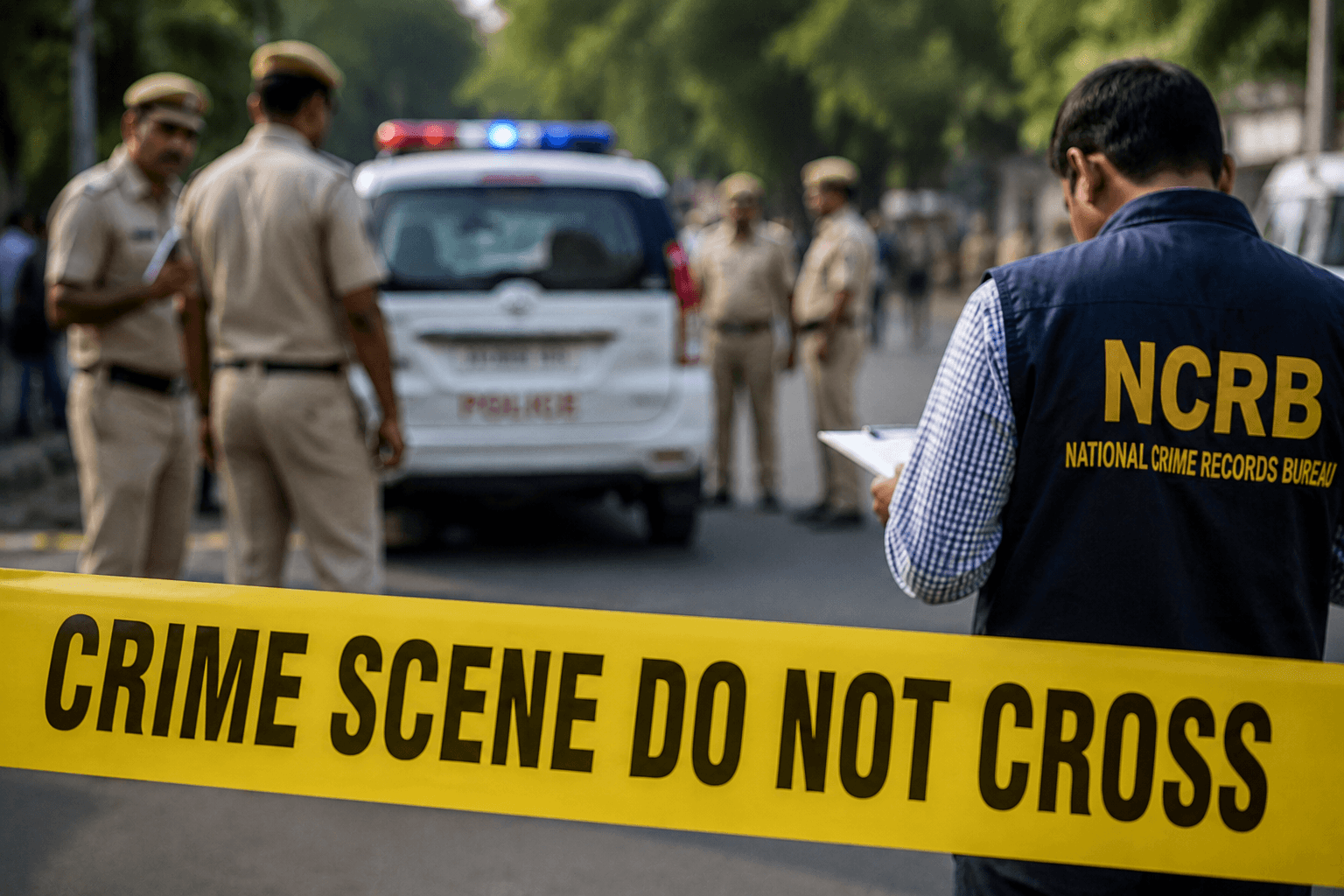
Major crimes reported by the NCRB agency.
There has been new 2026 data which is going viral across India, which is connected to crimes happening in India. It was provided by the National Crime Records Bureau. The data raise serious questions about how crimes are being dealt with and what kind of crimes are being specifically happening.
The types of crimes the data provided are crimes against women, kidnapping and abduction, robbery, crimes against senior citizens, murder and extortion, arson and violence, road accidents, vehicle theft, house theft, burglary, and cyber crimes.
The major places where crimes are being reported are Delhi NCR, Mumbai, and Bangalore are specific cities which have been reported. From street crime to digitally there has been an increase in cyber crime as the digital world is expanding rapidly. Post the pandemic there has been an increase in crimes, as criminals have seen new opportunities to exploit society through different means. It's not that the places where crimes have not been reported have no crime. It means many areas have not reported crimes in the records.
Data and Analysis ( Reference from NCRB)
*Over 2.7 lakh cases have been registered in the year 2024. In the years 2023 and 2022 have reported around 3 lakhs each year there has been a reduction in cases and crime in the last 3 years.
*Crimes 7,827,Kidnapping 5417, Abduction 5,603, Robbery 1,510, Senior citizen crimes 1,267,Murder 504.
*POCSO cases 1500 cases in Delhi, followed by Mumbai and Bangalore, approximately 1400 cases.
Street crimes which happened across India.
*Road accidents 1,521, vehicle theft 39,976, house theft 10,690, burglary 8,968, cyber crimes 404, extortion 228.
*According to NCRB data, most of the crimes happened in Delhi, Mumbai, Bangalore, Jaipur.
In the world, most crimes happen in Vennulezela, Papua New Guinea, South Africa. Most of the common reasons are political and economic stability, which makes citizens' lives difficult for survival, and which brings constant pressure for necessities.
In some places, crimes come under the influence of groups, gangs and unions. When it comes to the safety Index, India ranks 70 globally, the safety score is around 55 and the Crime Index 44. The crime happens according to the local circumstances and situations, depending on how the state is handling local issues.
Challenges
*Most of the crimes which happened are not being reported in India. Many crimes have been delayed in the judiciary and court procedures .
*Compromise of authorities during crimes involving corruption.
*False cases and target-based cases are being filed just to harass people for revenge and malpractices.
* Only specific areas which have been reported are being mentioned. What about the states which don't even report?
* Cyber crimes were tech based crimes, which cant be easily controlled and prevented. many people share OTPs, open wrong websites and links, spam messages and calls. It is difficult to detect criminals who are involved in cyber crimes.
* Summgling and drugs were authority and officials are involved by helping criminals.
* High levels of poverty, social inequality, discrimination among people, migration from other places, lack of education tendencies create immoral ethics and principles.
* Lack of fear about law and legal procedures.
* Groups, gangs and organized people have high influence in crime.
* lack of knowledge on digital tools and fear of visiting police stations due to reputation of family.
All crimes have to be checked aggressively and protect everybody from falling victims because of criminals. The citizens have to be aware and quickly report to the police and authorities. It would help in investigation and collection of evidence.
What does the government have to do ?
*The government has to ensure quick punishment and justice systems prevail.
* crimes which are being used for false intent and quick investigation procedure to deal with crimes.
*Open public visibility about crimes in the media and public spaces. Online and digital-based complaint systems across every corner of India, not only the capital.
*Bringing awareness for injustice, which has been happening to you.
*Awareness programs about crimes and severe punishments in the public domain create fear about crime and cases.
* Digital restrictions' privacy policy regarding cyber crimes has seen an almost 17% increase in crimes.
Bura Anirudh Yadav
May 7, 2026
 Policy
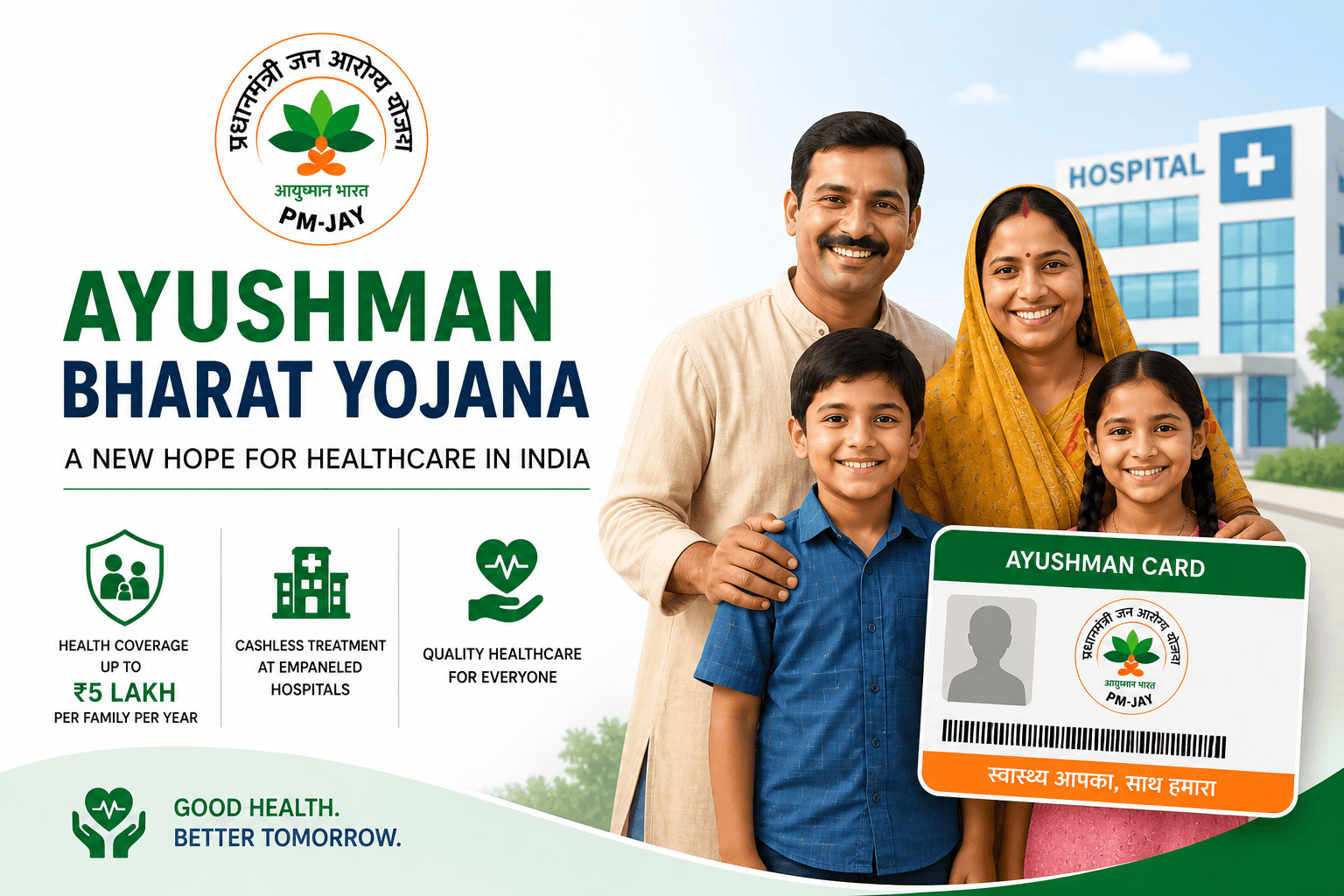
India is a country of more than 140 crore people, where access to quality healthcare is still a major challenge for many families. For a large section of society, medical treatment is not just expensive—it is often unaffordable. Many people delay or avoid treatment because of financial pressure, which affects their health and overall quality of life.
To address this issue, the Government of India introduced a major healthcare initiative called Ayushman Bharat Yojana. This scheme is designed to provide financial protection and better healthcare access to millions of families across the country.
Ayushman Bharat Yojana, also known as Pradhan Mantri Jan Arogya Yojana (PM-JAY), was launched in 2018. Its main aim is to ensure that poor and vulnerable families can receive proper medical treatment without worrying about high costs. Under this scheme, eligible families can get health insurance coverage of up to ₹5 lakh per year for secondary and tertiary hospitalization. The treatment is available at both government and empaneled private hospitals.
Before this scheme, many families had to spend their life savings or take loans for medical emergencies. In rural and low-income areas, access to hospitals and proper treatment was limited. Ayushman Bharat Yojana aims to reduce this burden by:
•Providing free or cashless treatment
It focuses on ensuring that no one is denied treatment because of lack of money.
•Health coverage up to ₹5 lakh per family per year
This makes it one of the largest government-funded healthcare programs in the world.
The benefits of Ayushman Bharat Yojana are mainly for economically weaker sections of society.
•Families identified through the Socio-Economic Caste Census (SECC)
Unlike many insurance policies, there is no need for premium payment from beneficiaries.
The scheme has created a positive impact by improving access to healthcare services. Many families who could not afford treatment earlier are now able to get proper medical care.
Some major benefits include:
•Reduction in out-of-pocket medical expenses
It also helps in strengthening the overall healthcare system of the country.
•Provides financial protection to poor families
•Lack of awareness in rural areas
Ayushman Bharat Yojana is a significant step towards building a healthier and more secure India. It reflects the government’s effort to ensure that healthcare is not a privilege but a basic right for every citizen.
While there are challenges that need improvement, the scheme has already made a meaningful difference in the lives of many people. With better implementation and awareness, it has the potential to transform the healthcare system and bring long-term positive change to society.
sonu vaishnav
May 5, 2026
 Policy
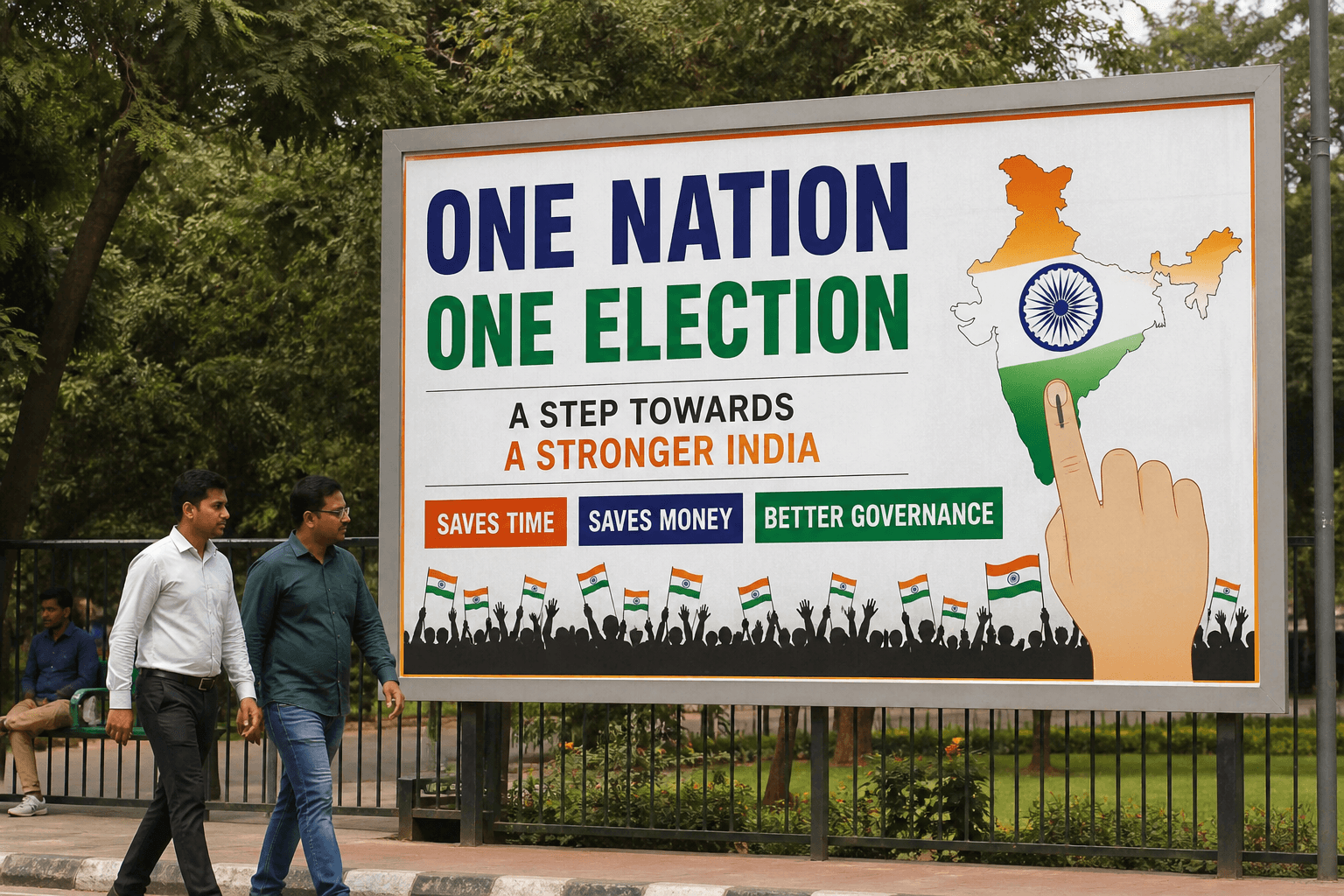
Why One Nation One election bill needs to pass quickly in India.
During elections we think about
1.when is it going to happen ?
2.Who is going to win ?
3.which party is better ?
4.Who are the leaders Contesting ?
5.What is the manifesto ?
but who is going to think of the cost of the elections ?
One nation, one election is one of the most significant issues which has always been in the limelight. The government always tried to implement it, but due to the opposition, it rejected the bill. The conduct of elections being held in various states at various durations indicates time consumption, which is beyond our imagination. We take elections as a pleasure and participate in them with high interest and enthusiasm.
The current elections in Assam, West Bengal, Keralam, Tamil Nadu and Puducherry raise questions about how the election commission is dealing with the election procedures.
It takes an immense amount of effort to conduct an election. At least 6 months preparation and all the development activities are stopped due to the election code of conduct, procedures get delayed as all the focus is on elections.
Reasons why One Nation One Election should be implemented.
*In India, elections play a pivotal role. Every part of India has elections in different contexts, from by polls to legislative elections from different states to bodies. It takes high time consumption, effort, manpower, and resources to conduct an election.
*To cut the cost of elections.
*To reduce delays in development activities or postpone projects and fund distribution.
*The reduction of government resources during the time of elections, where every government employee is being used for election procedures.
*Politics stops development, especially due to elections.
*In 2019, almost unofficially 60,000 crores were spent on Indian elections, making it the world's most expensive elections.
*The simplification of election procedures every 5 years instead of every other year.
These are a few reasons why one nation, one election bill is important for India. It will ensure cost-cutting of the election commission and faster growth for the economy. The major focus would only ensure development and the economy in society rather than delays, obstacles and politics.
Bura Anirudh Yadav
May 4, 2026
 Policy
*Do you know there was a time when holiday was not allowed ?
*Do you know workers used to work for 13 to 17 hours a day, with zero facilities ?
*Do you know people who died, bombs were hurled and gunshots wounded people in protests for asking for week offs in America ?
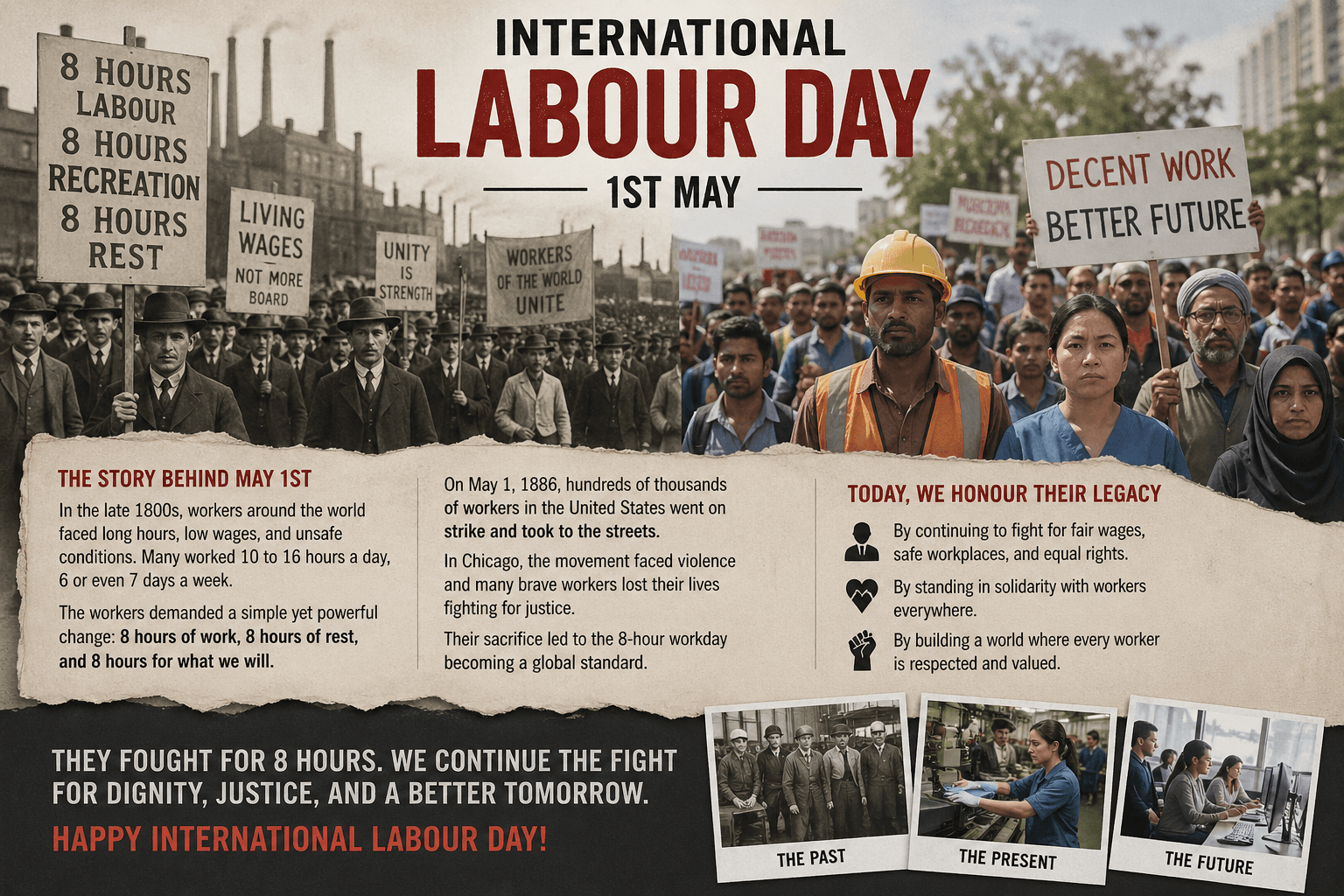
The International Labour Day has a significant history. During the time of the industrial revolution in the USA, factories were established. The workers merely had no offs, had to constantly work for many hours without even having a break. The factory owners used to sign contracts with employees using loopholes. In 1884, a federation of organised traders and labour unions was established by many workers, asking for demands.
They raised issues regarding an 8-hour workday by saying
* 8 hours of work
* 8 hours of Rest
* 8 hours for what we will
These slogans have created a ruckus and brought huge popularity across the US labour workforce. It created severe momentum for protests in all organisations working for employees. One fine day, all workers protested on a large scale in the USA. More than 3 lakh people have protested against the factory exploitation. The governments were shocked by the protests and the entire nation was crumbled and shocked by the people's agitations.
The same incidents have happened across India, especially Bombay, Kolkata, and Madras provinces. Many people have sacrificed their supreme soul for just 8 hours and a week off, it was now less than a freedom struggle for employees. After years of struggle, finally MAY 1st was declared as International Labour Day.
Bura Anirudh Yadav
May 1, 2026
 Policy
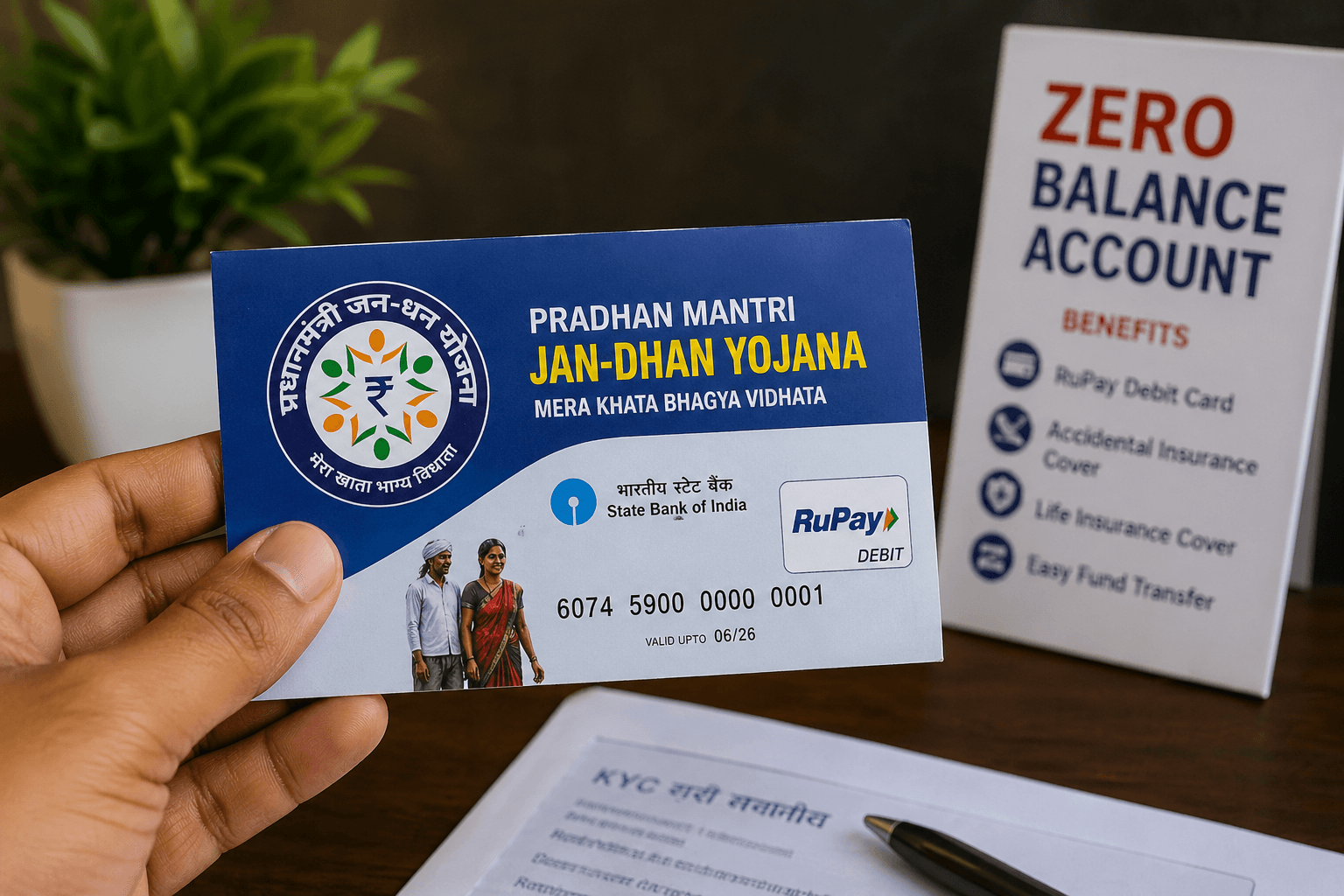
Pradhan Mantri jan Dhan Yojana, access to a bank account.
I got my monthly hard-earned money from my labour work, where can I save it ? If I don't save it, I might end up spending money on liquor or rats might eat the currency notes in my home. I have no safe place to save it, or I am neither educated enough to understand banking systems. How can I save this money for my daughter's wedding?
All these questions are for the poor people who have no access to saving their own money and are far away from government systems using only currency notes.
The government of India has initiated to include every individual having a bank account. It ensures financial inclusion through banking systems, allowing poor and illiterate citizens to participate in and learn the banking process. The eligibility required to open a Pradhan Mantri Jan Dhan account. All you need is an Aadhar card and an age above 10. It will help by giving zero-balanced accounts and an insurance cover of 2 lakh rupees accidental insurance coverage and 30,000 life coverage.
56 crore accounts have been opened till now and 55% of accounts have been opened by women. 20% of accounts are not operated. Some accounts have duplicate accounts by opening accounts by opening twice in other states by migrant labour. There is a huge connectivity issue in rural areas and security concerns about OTPs, banking procedures or ATM cards. Overall, it helps poor and marginalised citizens help with connecting banking systems and save money in banks.
Bura Anirudh Yadav
April 30, 2026
 Policy
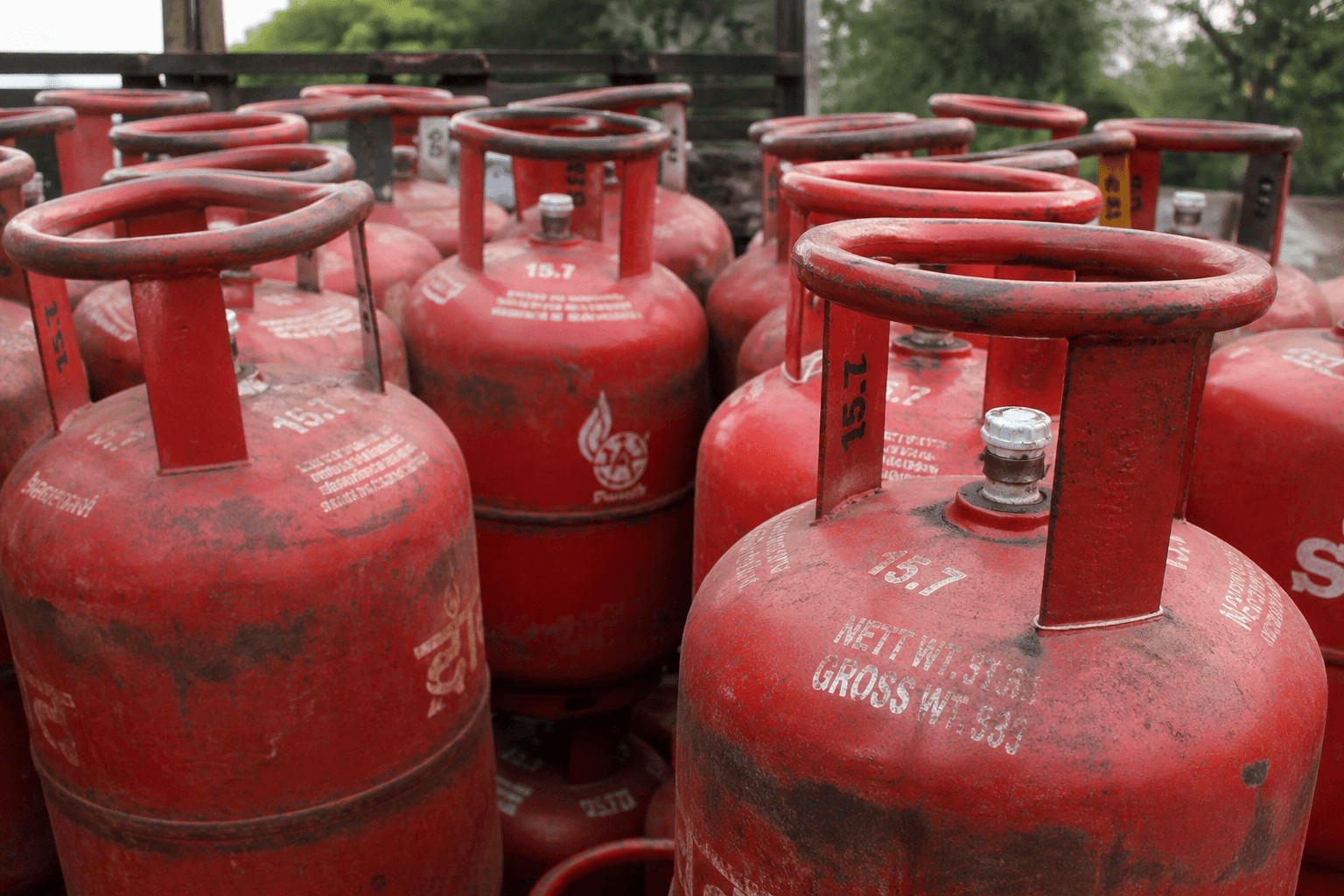
The West Asian conflict which created massive havoc in many parts of the world. The supply of oil, gas and resources has been kept at a halt. The Strait of Hormuz, an essential route of supply, has been hit by the crisis. The LPG issues which are specifically being dealt with by India are still in the danger zone. For the last few days, conflicts have been constantly going on.
During this situation, India is almost dependent on other nations for energy resources, so the supply requires high attention to reach each individual. The crisis has led to massive black market rackets being operated, with misusing malpractices and trying to make excess money out of people's needs.
The government has issued new rules starting from May 1st incorporating a set of rules to provide better facilities to the people.
A 21 to 25 day time period for booking of cylinders in urban areas, whereas in rural areas a 45-day time period has been given for bookings.
OTP-based cylinder booking will be mandatory with access to an Aadhar card KYC number, which has to be linked to your mobile number.
The supply situations will be improved by providing cylinders on time.
The black markets are causing trouble for people by providing them with high prices, around 4000 to 5000 rupees for 1 cylinder, and some even take two cylinders with influence. Due to the high prices, the hotel and restaurant industries have hiked food prices about 20% since the West Asia conflict. The essential services which are in high demand and necessary for people need to be controlled from wrong practices. The commercialisation of goods has created price rifts and questions being hurled at governments over irresponsible measures. The government has taken stringent actions on black market agencies who are selling cylinders with double prices. LPG companies will increase the price to 60 more rupees. The new rules will be effective from May 1st of 2026 and will assure the stopping of black market rackets with efficient control of LPG misuse. The government bypassing the rules would be punished with severe punishment, as per the government advisory.
Bura Anirudh Yadav
April 29, 2026
 Policy
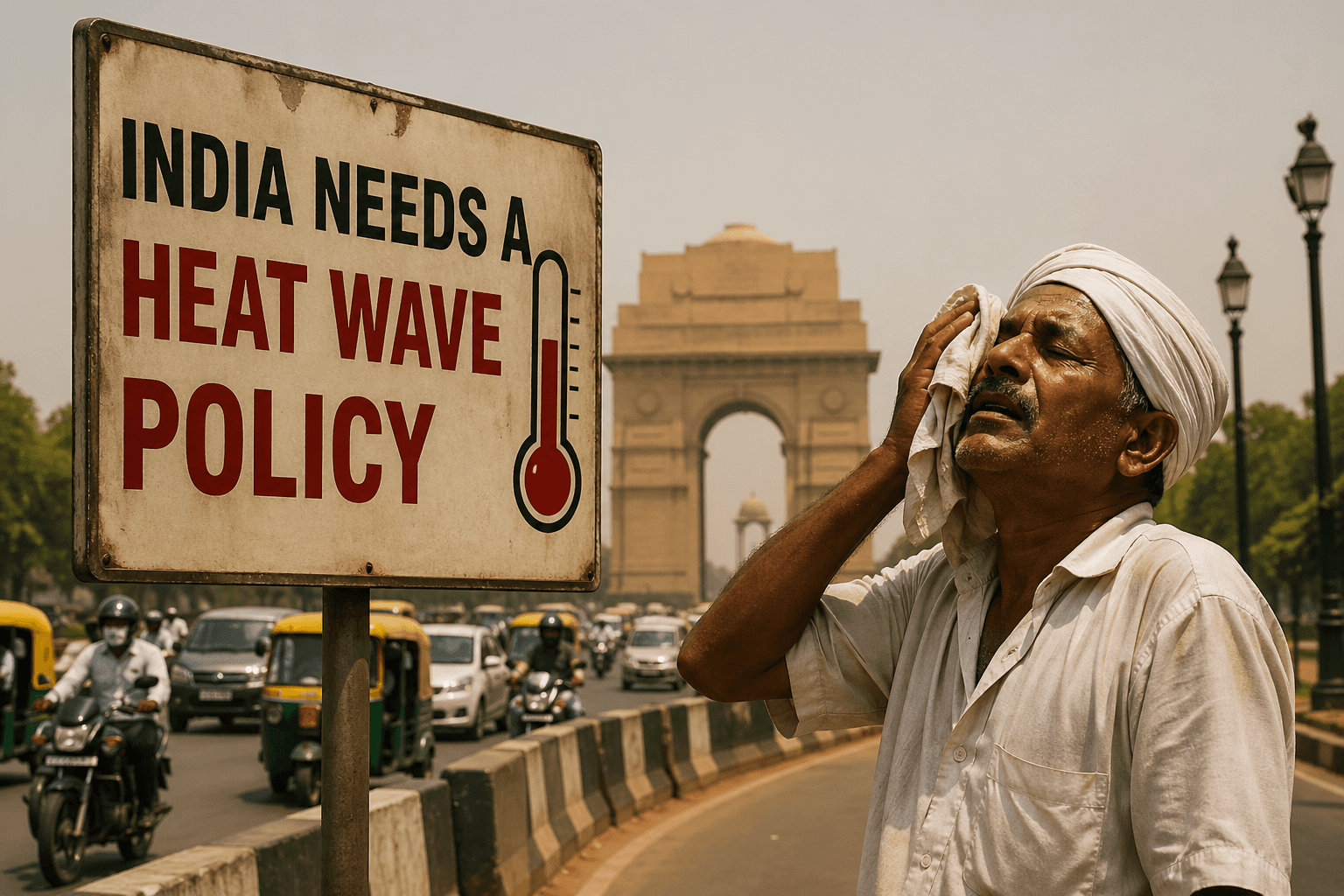
Heat waves across India IMD warns of a severe heat crisis.
How does the sun shine in India right now ?
India has witnessed 40 to 46 degree temperatures in many parts of the country. The global reports significantly point out that India is burning and requires heat protection mechanisms. We need to introspect our climate and environmental concerns after warnings have been issued. India is burning due to severe scorching heat waves, states like Uttar Pradesh, Maharashtra, Bihar, Haryana, Madhya Pradesh, Rajasthan, and Punjab are severely impacted by heat.
The people in the afternoons especially can't even step out of their homes. From sugar cane to watermelon have been the only temporary cure to protect ourselves from devastating temperatures. The demand for cold and liquid diets has increased. Air conditions and water coolers to protect themselves. As time passes, the increase in major global warming changes every year from extremely hot climates to freezing and uneven temperatures in the middle of the year. It indicates how humans are creating ruckus on the planet.
The government has to take stringent measures and follow proper protocols.
* By having more tree plantations and protection.
* Providing citizens with water resources for effective management of daily life's needs.
* Strict and stringent rules in case of misuse of resources from lakes, ponds, rivers.
* Green ecosystem across concrete urbanisation with plants, creating artificial water bodies.
* Places like Delhi NCR, Mumbai, Ahmedabad, Lucknow and all urban places need inbuilt green cool roofs on buildings, flats and streets. Already, a few cities have started Blue Green Infrastructures.
* Plantation drives * campaigns to deal with environmental issues.
* Using traditional methods in rural areas.
* Reduce deforestation and implement strict fines and punishment.
Doctors Suggestions during severe heat waves.
Many experts advise people regarding the summer heat waves.
*Avoid going out during afternoons.
*Intake of fruits, liquid diet and water consumption are essential.
*School-going children and the Labour workforce need more protection from severe crises. They are more prone to dehydration symptoms.
*Wear light coloured clothing.
*Avoid highly intense physical activities.
*At least 3 to 4 litres of water consumption.
*Keep your home cool.
Due to extreme climatic conditions, there is a high chance of heat stroke, fatigue, weakness, dehydration, excessive sweating and dry mouth can impact you. Keep your family safe by following proper precautions this summer. The government has to take clear measures and plan effective policies by analysing proper climate control. Climate issues should be the major manifesto options for politicians. The future is decided by sustainable climate action measures, which provide a great life for our next generations to come. The population growth, excess resource utilisation and an increase in urban infrastructure are the major causes for the rise in temperatures.
Bura Anirudh Yadav
April 27, 2026
 Policy
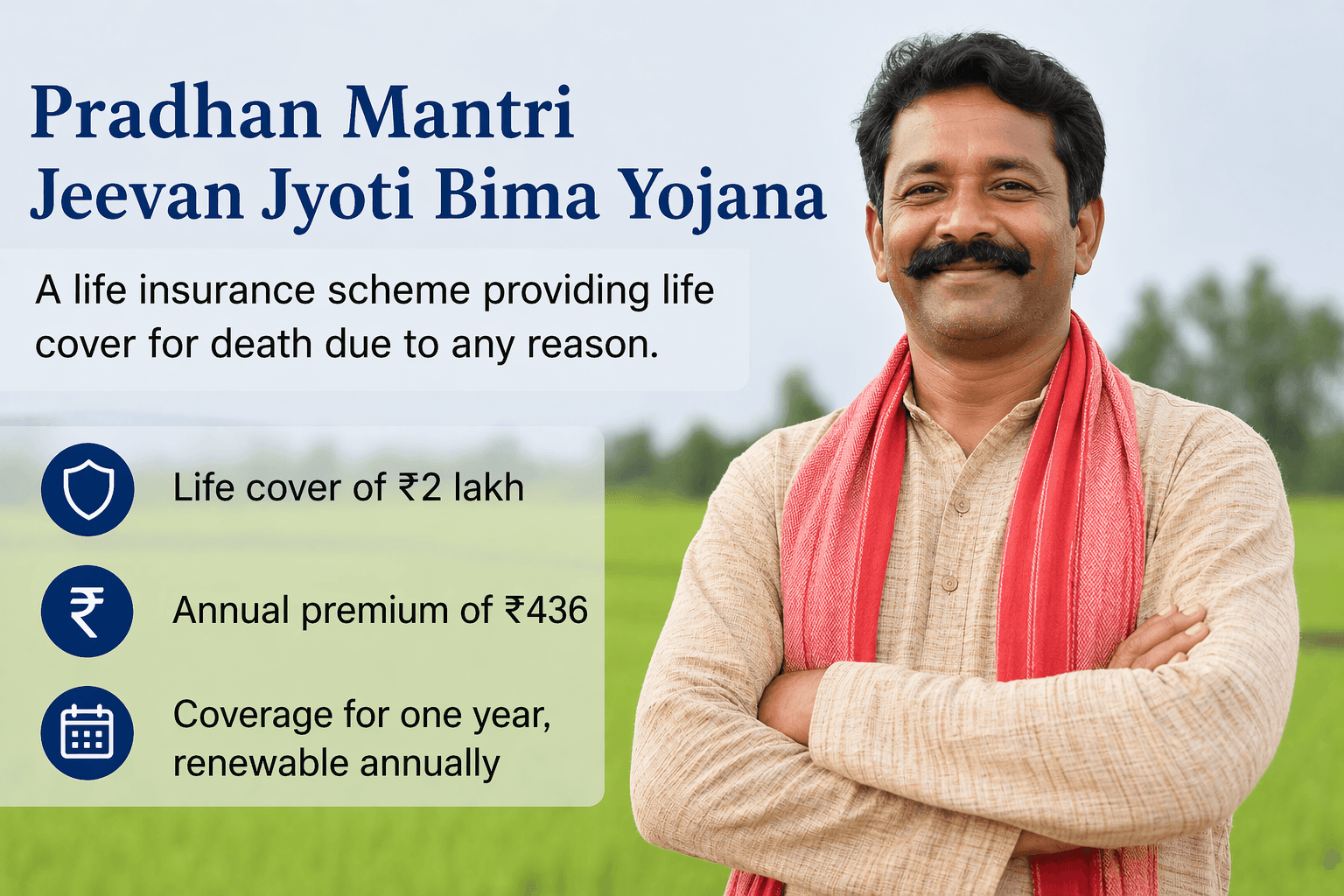
Pradhan Mantri Jeevan Jyoti Bhima Yojana
Every human being goes through deep emotional pain during a few life incidents, which crumbles the entire family.
A middle-class family with a basic income with only one person earning in the family meets an uneven accident.
* Can you imagine the entire family situation? Can you feel what kind of pain they might go through ?
* Elderly parents go through health issues and death happens. What about the future of the family ?
* The hospital expenses and family conditions for daily life purposes, how will the wife and children handle such circumstances?
The government of India started a policy where uneven incidents shook the family with deep emotional pains where 2 lakh rupees were given to the nominee.
How does this policy work ?
The person should pay an annual payment of 436 rupees, the
The policy provides for 1 year and which is renewable annually.
Age Limit: 18 to 50 age group people, and you should have one savings account, bank account only, and a post office, and ask for PMJJBY. Accident death is covered from day one of the policy and normal death before 30 days is not applicable. The death benefit which the nominee receives has no tax payment on it. You can have a bank savings account or post office account. Both are eligible.
This policy will surely help your family and loved ones during their death. The security of the family would be sustainable even after passing of the only income earner of your family. Kindly learn regarding policies which the government provides and enrich society with knowledge through bringing awareness.
According to the government, almost 23 crore individuals have enrolled in this policy in which the government has settled almost 9 lakh cases until now. In total, claims received 10 lakh cases were received, and 32000 cases have been rejected by the government over false claims.
It is surely one of the life-saving policies to help your family during difficult times.
Bura Anirudh Yadav
April 24, 2026
 Policy
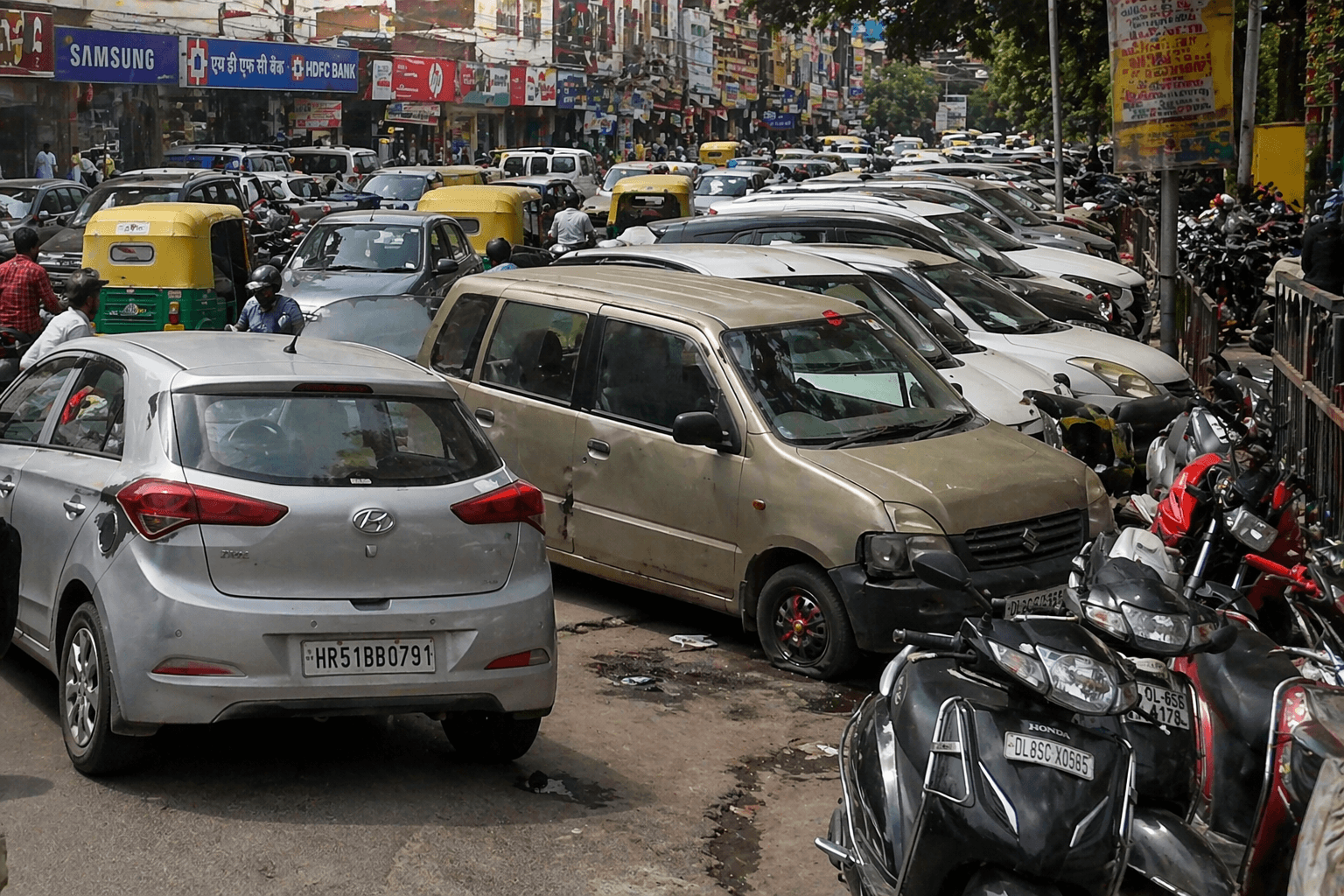
India needs a strict parking policy, to avoid chaotic scuffles on the streets.
Have you ever faced difficulty with parking your car?
Whenever you stop your car on the streets just to buy some groceries, a 3-minute parking can create ruckus on the streets by creating huge traffic jams, followed by abuse, arguments and sometimes violent fist fights.
A recent incident where a 30-year-old man was beaten to death in Noida over a long argument during a car parking. This incident indicates that parking a car is no longer an easy task in India. Almost 40 crore registered vehicles in India, especially in urban areas, with the population continuously moving out for offices and business. Early morning, around 9 am to 10 am, at peak office time, hundreds of vehicles come on the streets, showing how difficult the situation on the streets is. From pollution to congestion and overly populated vehicles create even more complexity.
Every other minute there are some kinds of parking issues happening around us. I can share most of the parking chaos so that you can feel it.
Problems and major parking issues happen near these places constantly.
* Early morning schools around 8.30 am with school buses for dropping the kids in their own vehicles. Auto rickshaws stopping near the school gate. None of the schools have parking facilities and dropping area stops. The entire road is covered with vehicles. The same happens in the evening from 3 to 4pm at the pick-up time.
* Shopping and theaters, especially during peak festival season, and famous movie stars' film release day.
*Sunday markets and grocery shopping with hundreds coming out of homes with their own cars.
* Morning 9 am to 10 am and evening 6 to 7 pm office timing, especially in the IT sector region, with constant traffic jam issues.
* Political rallies and leader' meetings, entire roads are blocked; there is no space to wait or move.
* Local bazaars and markets in India have zero parking spaces.
These are some particular places where parking issues are constant. As the population is growing rapidly and the buying of vehicles is getting normalized, as of 2026, almost 60% of the population has basic vehicles in India. It has become a basic necessity in every household.
The government has to create a policy, particularly regarding parking issues. We have a few suggestions for the people and governments.
People
1. Park the car properly and think of others' well-being also.
2. Use more public transport or two-wheelers for basic groceries.
3. Identification details on your car can help others to inform you in case of the wrong parked car.
Government
1. Implementing strict fines and rules over people parking in the wrong place.
2. Taking proper measures in schools, shopping complexes, political rallies, movie stars, office timings.
3. Inducting more traffic police and a new police branch only for the parking control police authority. It would give employment opportunities and traffic jam control from chaos.
4. Only give permission and permits to those who have parking space only. Not only on paper, but practical checks should be done.
5. Identify chaotic places and prepare for widening of roads near local markets and busy places.
6. Make identification numbers on cars mandatory. In case of wrong parking, the person can call or text the unknown member to clear the traffic.
7. A family should have only 2 vehicles, not more than that.
8. Promoting public transport usage more aggressively and initiating more public transport methods.
9. Having proper spacing of roads and lanes or illegal construction.
10. Selling vehicles based on necessity rather than from an economic growth perspective.
These are some measures where the government can change the parking issues across the nation, create a positive environment and hassle-free from parking chaos or conflicts.
Bura Anirudh Yadav
April 21, 2026
 Policy
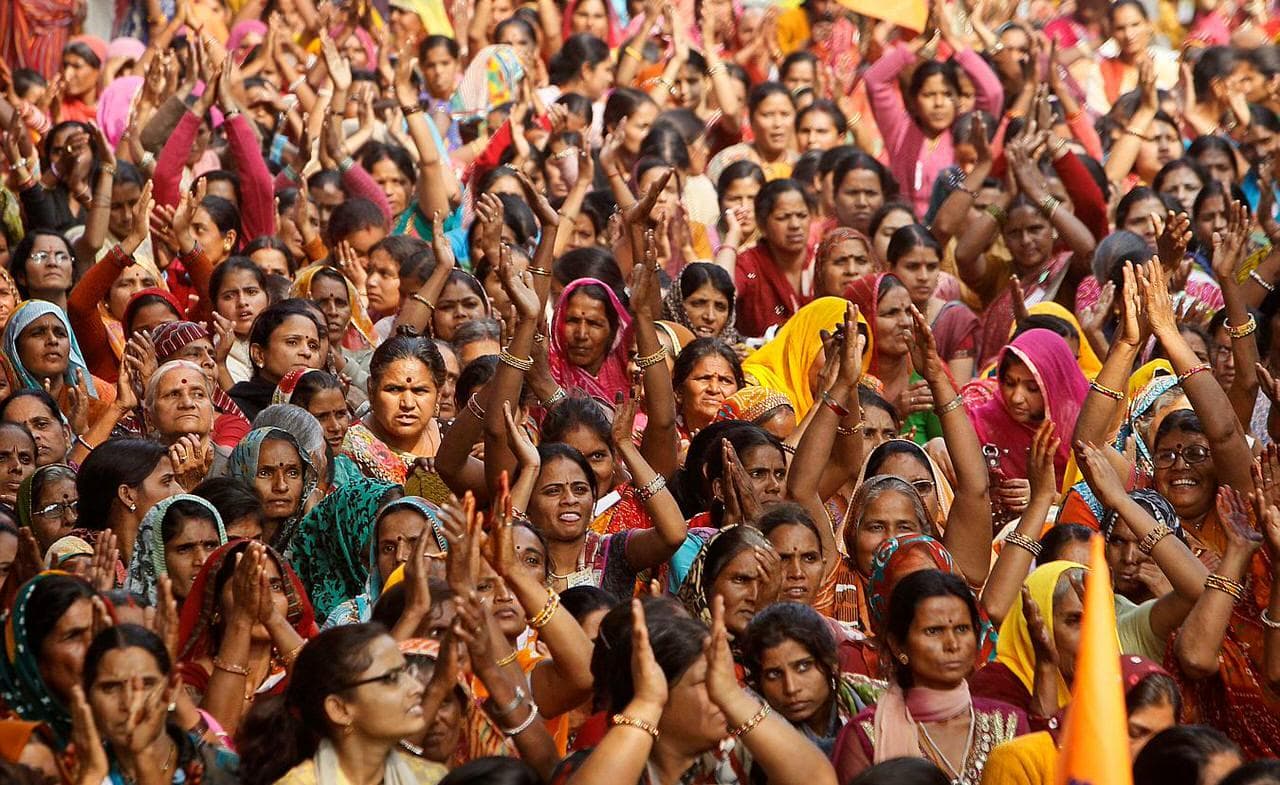
Nari Shakti Vandan : 33% support for women participation.
The Government of India’s push towards women empowerment and participation in the political spectrum, to address women-led policy making participation. The bill was passed in 2023 but due to various other delays, lack of data and delimitation procedures have been kept on hold. This bill has got support from all the parties, to contribute towards women's participation. The new India recognizes the capacity and caliber of women-led participation in the fields of science, education, sports and also the large scale of women participating in politics too. The vision aims for women to contribute more to decisions and governance. It is about women's self-respect, not only household chores but policy making and influencing the decisions of the government.
Right now, women's participation in parliament is 14 to 15%. The government's vision to implement a 33% reservation by 2029 will cause major changes politically. The Nation building procedure needs various amounts of knowledge and opinions to make the right policy. The problems women face in their personal life and the voice which has to be heard in a democratic country needs more effective measures. Only in certain urban areas women's participation is visible due to education, family support, freedom to act on self-made decisions.
Have you ever thought about rural women and their struggles?
The real problem and situations emerge in villages, so it requires enough measures to raise the voice in the democratic system. The equality between men and women, especially in politics, is almost unmatched. Politics requires high-stress-level environments and, being a woman, it is difficult to give the right amount of time required to deal with politics, societal pressure and humiliations. Historically, it was always dominated by men and even today all decisions are taken by men. The new shift in this policy will enhance a new way of decision-making procedure. Most women in rural areas do not even participate or don't even come out of houses. The situations are beyond our imagination. This reservation helps them bring self-respect, help and courage to deal with society.
What changes can women bring when women participate more in politics ?
The ability brings women’s issues and expresses a different perspective in the decision-making process. Understanding what real issues women go through in rural and marginalized regions of India. A strong voice against injustice and breaking the old rigid mindset.
Improves gender equality among men and women. Helping individuals with deep concern and women have high levels of understanding capacity, which will help them to do less self-service to society. The new India vision of 2047 will emerge with great development and equality in nation building with rights for women in all sectors of the society.
Our aim is to create awareness to support youth in building a better future through business opportunities.
-For Business kindly follow Onetick technologies
- For loan consultation contact -Loan Sugam
Bura Anirudh Yadav
April 16, 2026
 Policy
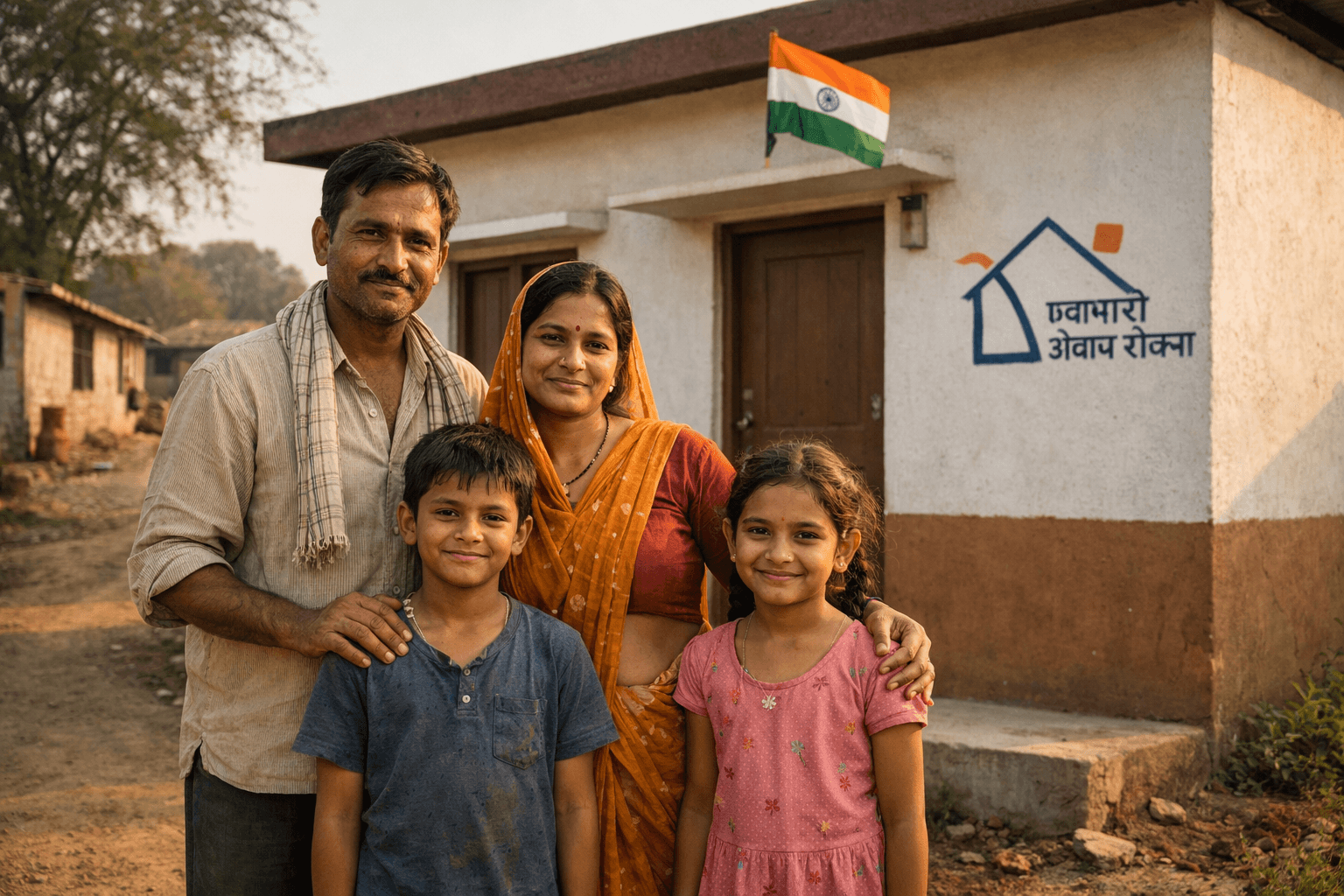
Pradhan Mantri Awas Yojana: A New hope for life.
India is a country with a population of more than 140 crore, so it is a deep-rooted problem in society to fulfill its aspirations. Nobody has basic requirements and amenities. The constant struggle for survival and security is the major concern of mankind. The government of India introduced a security measure to provide shelter by providing houses to people who are in need. Having an independent and self-claiming house is a dream for many, the poverty and pain of not having a house is unbearable.
The Pradhan mantri awas yojana provides shelter to poor and marginalized sections of society to give them a better future and security, so that they can live with dignity and feel empowered. The PMAY was started in 2015 with a mission to provide houses. Till now, 125.15 lakh houses have been sanctioned, 97.3 lakh houses completed, the central assistance fund which was allocated 2.09 lakh crore. The data have been taken from the Ministry of housing and urban affairs website.
The eligibility for getting PMAY benefits: one should have ‘No’ pucca house and have never previously taken any benefits from the government. The policy majorly targets poor, middle class citizens who can't afford basic needs. A loan amount of 6 lakhs with a 6.5% subsidy is given to EWS citizens and a loan term of 20 years. The data has been taken from My gov website. The categories involved in LIG and MIG would be given from 9 lakhs to 12 lakh with an interest subsidy of 4 to 3%.
Advantages and Challenges
The government providing basic security gives poor people to uplift their lives. It gives hope to the citizens that the government's policies are effective and efficient. The houses provided can help generations to settle down and work on other things which are necessary to survive in society, like education, health and security for children. The government spending huge amounts of money on the PMAY scheme provides economic growth and development of the entire region where houses are being constructed.
Overall economic growth of the nation and the reputation of the nation in the world over reduction of poverty. It proves how democratic procedures can create a huge change in society by giving such large-scale loans and helping the poor to build houses. There might be bureaucratic hurdles and slow procedures for providing loans, and an increase in population could impact more eligible profiles to give more PMAY, which will make land allocation difficult. Lack of proper documents and mismanagement of documents to gain more benefits. Repayment of loan procedure in 20 years which can put more pressure on the government.
Our aim is to create awareness about the Yojana to support youth in building a better future through business opportunities.
-For Business kindly follow Onetick technologies
- For loan consultation contact -Loan Sugam
Bura Anirudh Yadav
April 16, 2026
 Policy
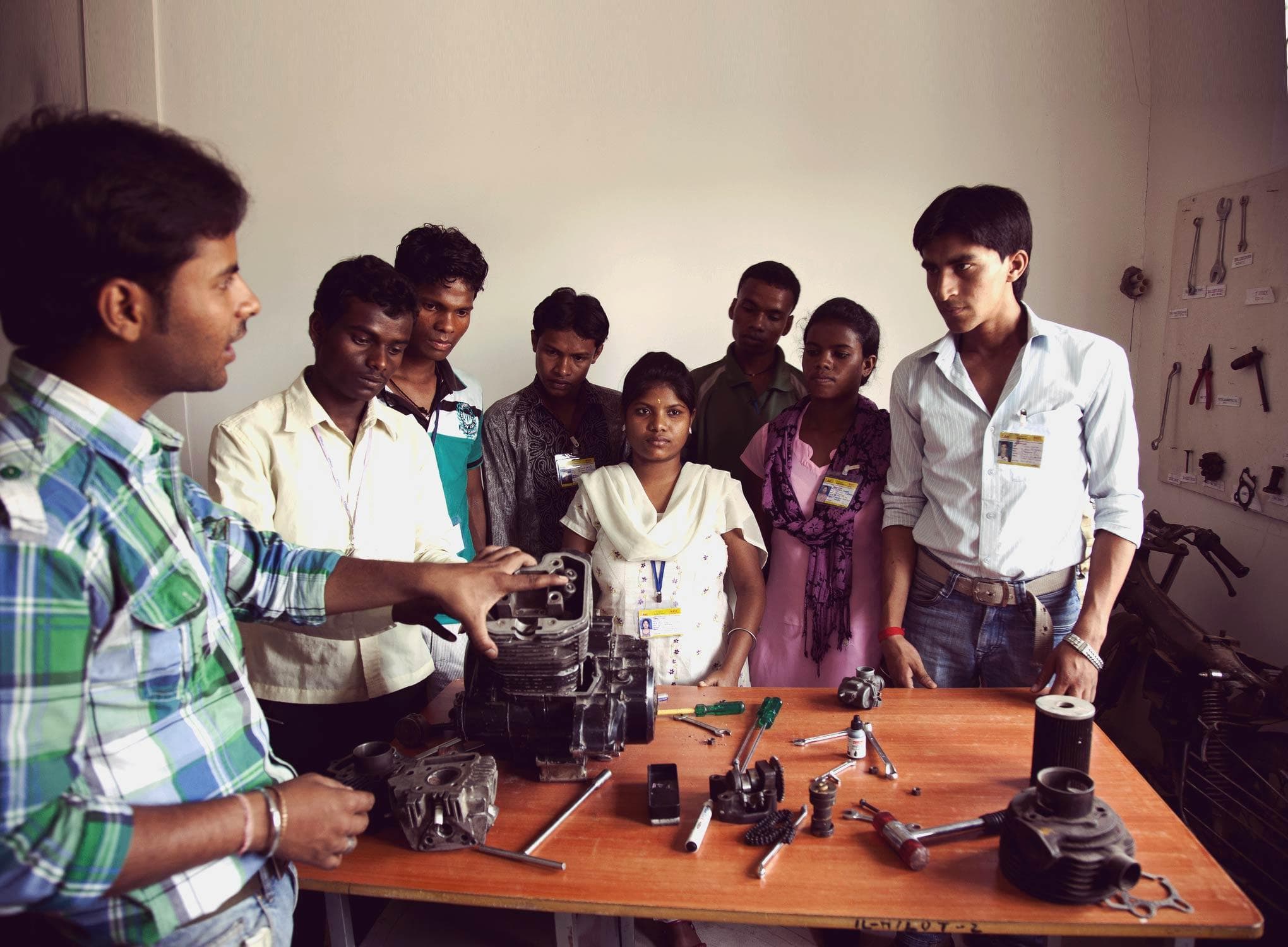
Skill India: Opportunity for Future Growth
In the world of tech-driven and competitive pressure, human beings have to adapt to new things for survival. The young population of India has to learn advanced level skills.
The skilled mission of the government of India is to establish a credible workforce and for economic stability. India has a young population which other countries do not have. The workforce has gained tremendous pressure due to lack of skills. The government has to evolve and help young people to gain skills. The learning of skills will give great opportunities and would create lifetime earning abilities. Our schooling system is based on learning and understanding rather than practical knowledge. The average youth with a degree cannot earn as much money as a skilled one. It is creating hurdles in our system. When it comes to money making more than knowledge, skills take the first seat. The economic boost needs the human workforce to be capable and expects them to create jobs for others.
What happens when every other youth is skilled? Have you ever thought about it?
When all young people are skilled and capable of creating and executing things, it would reduce the burden on the nation. There won't be any kind of violence or unnecessary
Protests due to a busy schedule. The people would learn the skills and earn their own livelihood instead of depending on governments. It will give them scope to start their own startup company and provide new opportunities for the needy. The country's economic growth and GDP will increase overall. A responsible country needs citizens who are worth creating wealth and hard work to accomplish bigger things. Every skilled person is an asset to our country rather than a liability. Establishing more self-manufacturing units and labour force. The skills that generate wealth bring a better lifestyle for the youth.
When every youth is unskilled, what might be the consequences for the nation ?
A person with no skills is a liability to a nation, society and family. The person might be considered irresponsible in every aspect of life. It will be extremely difficult for governments to generate wealth. To give subsidies more frequently rather than collect taxes. It will lead to rebellion against the government, jealousy towards elite people in society and leads to corruption. The nation keeps on fighting protests, crimes and politically unstable with governments changing frequently, like Pakistan, Bangladesh, Nepal. The resources are not multiplied, it will be reduced with time. It creates more dependency on other countries to get resources, exports value will be reduced and imports become a prime aspect of countries being run on it. Jobless youths directly indicates a lack of credible government.
So what should every other person do to become skilled and responsible ?
Our education system should start teaching skills as a subject from school level.
Along with regular academics, a learning skill is mandatory. Money-making skills rather than rote learning with degrees. Teaching law systems to ask governments for accountability and transparency. Establishing harsh rules and practical exams, rather than only written exams. Teaching business and money-making skills at school level.
Skill India mission provides required skills to establish and following it, would give an opportunity to learn. The future requires more skills than education to survive. Education gives you knowledge, but India needs skill and knowledge together. Legalizing internship and work experience is mandatory.
Moving towards new places to learn and adapt to work, constant movement would always improve better life skills.
Bura Anirudh Yadav
April 16, 2026
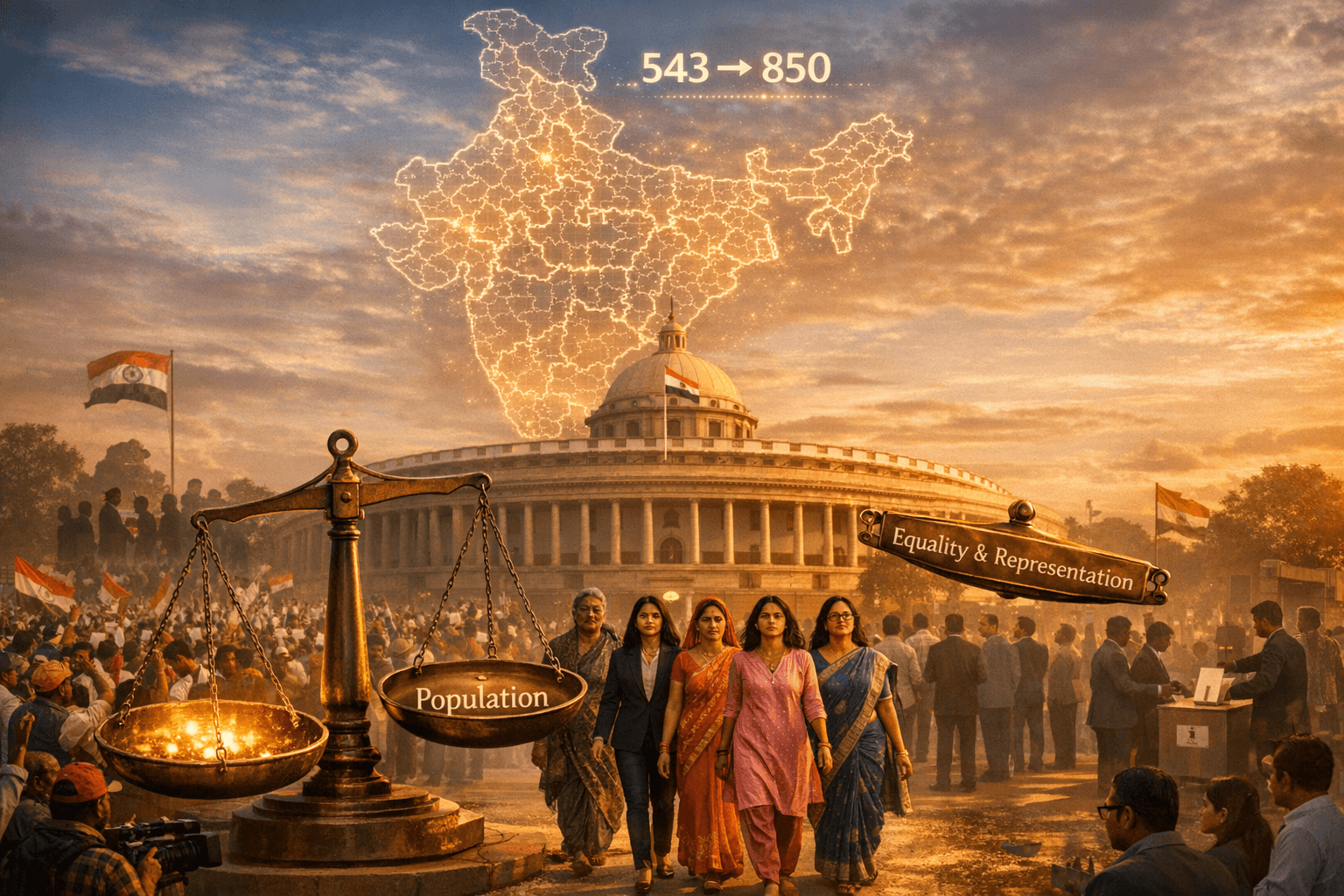 Policy
Delimitation & Expansion Of Parliament Representation.
The center has indicated a massive political debate on the Delimitation process. The union government wants to increase the seat sharing from 543 seats to 850 seats and an increase of 33% reservation for women to participate in the political arena.
Political representation helps to enhance large scale development projects and deep-rooted governance. By 2029 the government wants to implement a new way of governance as per the current government. The leaders of the government of India have given clear assurances that there won't be any discrimination against any region.
As per the population basis, the government wants to increase representation, but the narrative says that states like Bihar and Uttar Pradesh will get more dominant politically.
The southern part of India would have reduced its representation, as per many political leaders. The delimitation is purely based on population growth, so technically, most seats would be given to the northern part.
Advantages of Delimitation and Challenges.
The limitations enhance a new way of governance, and there will be easy access to welfare policies for every citizen. It gives new representation of leaders and more public engagement. More effective policy making and parliamentary procedures. Increase in more democratic procedures and opinions from all parts of the country. The women's representation of 33% will definitely help to address women-related issues and women empowerment. Decentralization works effectively and efficiently with strong work ethics.
Challenges
The representation of a few states will more likely become dominant, and few states would lose their voice and political representation. The increase in representation would create more hurdles to quickly make a rule and regulations. The more political conflicts and competition would increase in the local well. Only one being in power for a long time might be possible.
States with less population would reduce their worth and Uttar Pradesh would get high importance due to seats and shares.
What can we do for better delimitation procedures which can bring equality?
The government should not only consider the population but also consider the poverty, skills, economy segment too. Increased seats should be reverified and work only as per requirements. The government should form high level committee and with help of Niti Ayog, a proper policy should be framed. Explain the reasons to the society for delimitation process with evidence and facts. The delimitation process should not feel isolated or cornered for a few states; it should help in a more active participation process. The democratic identity of states and one-sided election results or support is a threat to democracy.
Our aim is to create awareness to support youth in building a better future through business opportunities.
-For Business kindly follow Onetick technologies
- For loan consultation contact -Loan Sugam
Bura Anirudh Yadav
April 15, 2026
Weekly briefings on the regulations, reforms, and rulings that will shape your business.