
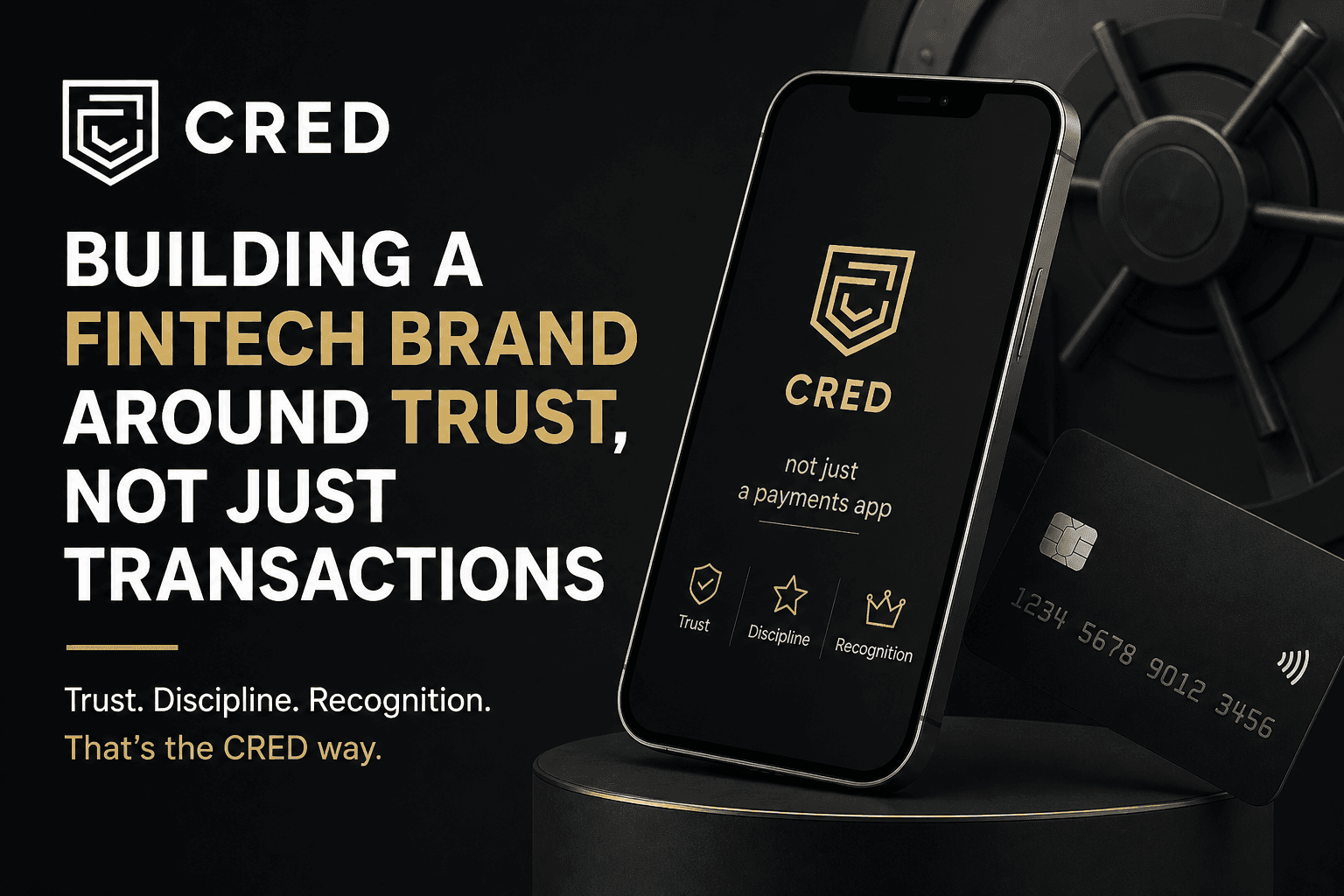
Building a Fintech Brand Around Trust, Not Just Transactions
In India’s fintech space, most products compete on the same things—cashback, discounts, and aggressive user acquisition. The assumption is simple: attract as many users as possible, then figure out monetization later.
CRED took a noticeably different route.
Instead of going mass, it started with a filter. Only users with a strong credit profile could join. At first glance, that feels like a growth limitation. But in reality, it was a positioning decision.
The Core Insight
The idea behind CRED is not complicated, but it is sharp.
Financial platforms usually exist to correct bad behavior—late payments, poor credit usage, lack of access. CRED chose to focus on the opposite side of the spectrum.
What about users who already do everything right?
They pay on time.
They maintain a healthy credit score.
They are financially disciplined.
Traditionally, these users get convenience, but not recognition.
CRED turned that into a product opportunity.
Product as Positioning
From the beginning, CRED was less about utility and more about experience.
The interface is minimal. The tone is premium. Even the onboarding process feels selective.
This does two things:
- It builds a perception of exclusivity
- It attracts a specific kind of user—urban, financially aware, digitally comfortable
That combination is valuable, especially for partnerships and long-term monetization.
The Founder’s Lens
A lot of this thinking reflects how Kunal Shah approaches products.
He has often emphasized that trust and behavior are more powerful than short-term metrics. Instead of chasing scale immediately, the idea is to build a high-quality network first.
This is not the fastest way to grow. But it can be a durable one.
Where the Model Gets Interesting
CRED’s strength is also its biggest question mark.
By focusing only on high-credit users, it creates a strong ecosystem—but a limited one.
That raises a few important questions:
- Can a premium-only user base sustain long-term growth?
- How does the platform monetize without affecting user experience?
- At what point does it expand beyond its initial segment?
These are not weaknesses, but they are real strategic decisions the company continues to navigate.
Beyond Payments
Over time, CRED has moved beyond just credit card bill payments.
It has introduced:
- Rent payments
- UPI features
- Credit lines
- Financial tools
This shows a clear direction—becoming a broader financial platform rather than a single-use app.
A Broader Context: Building in India
CRED’s journey fits into a larger conversation about India’s startup ecosystem.
Recently, Sridhar Vembu shared an open letter encouraging Indians abroad to consider returning and building in India. His argument was not emotional, but practical.
A country’s global standing increasingly depends on its technological strength. And while India produces strong talent, much of it contributes outside the country.
He himself made a similar choice—returning and building Zoho Corporation with a long-term, product-first mindset.
Why This Matters
Startups like CRED represent a shift.
They are not just trying to replicate existing global models. They are experimenting with positioning, user segmentation, and experience.
That’s an important evolution.
Because long-term ecosystem growth doesn’t come from copying—it comes from building with context.
Final Perspective
CRED is not just a fintech app solving a payment problem. It is a product built around behavior, trust, and perception.
Whether its model scales perfectly or not is still an open question.
But what it has already done is clear—it has challenged the default way of building consumer finance products in India.
And in a growing ecosystem, that kind of shift matters more than short-term results.